
Before the Storm
The rain announces itself before it arrives.

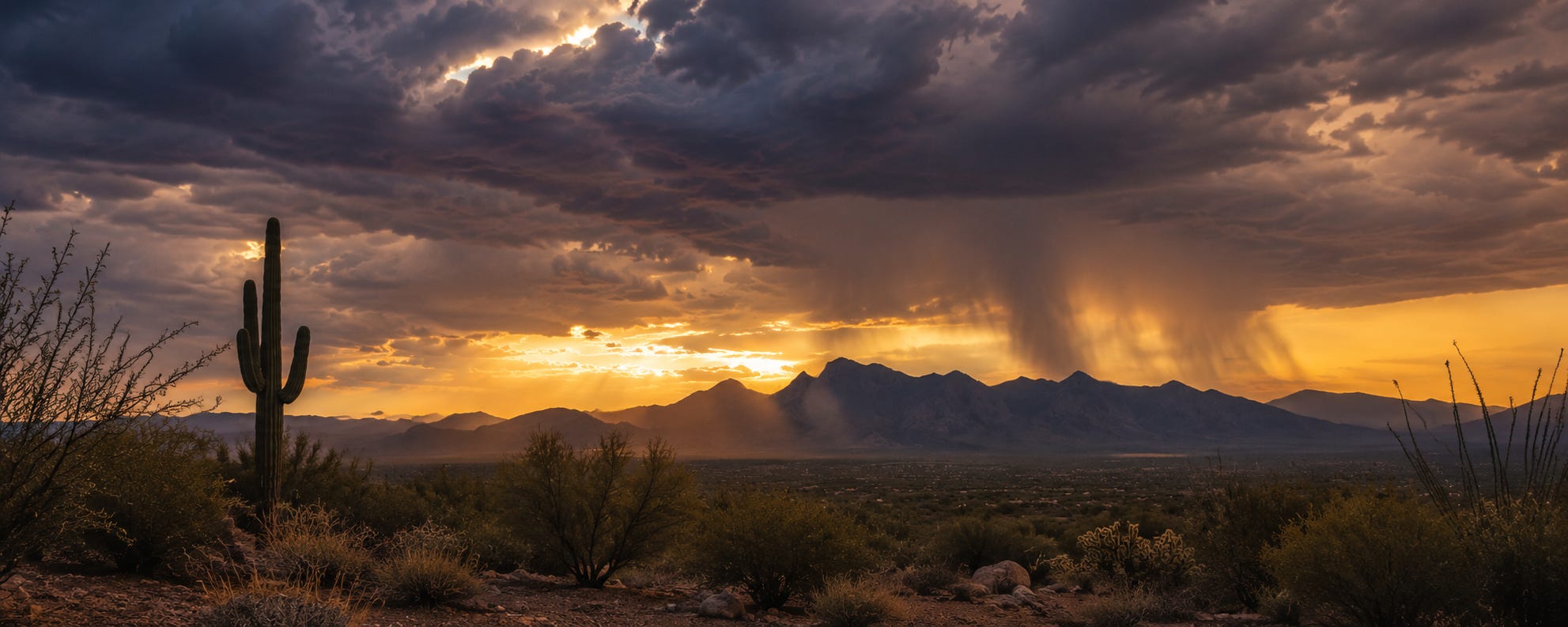
This is my first July in the desert, and I am learning to read the sequence. The light goes soft and yellow in the late afternoon, then bruised. The wind shifts and comes from the wrong direction. The doves stop calling. The regular hum of desert life drops out mid-phrase, all at once, as if someone lifted the needle from a record.
And then the smell. Sharp, resinous, unmistakable. Creosote. The scent rides in on the outflow winds, carried from miles away, because somewhere out past the mountains the rain is already falling. The smell is not a prediction. It is a report. The storm you are waiting for has already begun, just not here, not yet.
It doesn’t take long before the desert starts teaching you to pay attention.
You stand in the driveway and you know. Nothing has happened where you are standing. Everything has happened.
The Place He Did Not Know
In this Sunday’s Old Testament reading, Jacob is running. He has cheated his brother and fled his home, and night catches him in the open with a stone for a pillow. He dreams of a ladder set up on the earth, its top reaching to heaven, angels ascending and descending. God stands beside him and makes promises Jacob has done nothing to earn.
Then Jacob wakes, and says the line the whole story turns on: “Surely the Lord is in this place, and I did not know it.”
Notice the tense. Not the Lord has arrived. Not the Lord will come if I build an altar. The Lord is in this place, and was, the whole time Jacob was arranging his stone and closing his eyes. The presence preceded the perception. Jacob did not summon God to Bethel. He woke up to what was already true.
Again and again, Scripture tells the same story. God acts first. We notice later, if we notice at all.
The Sound of Sheer Silence
Elijah had to learn the same thing, and he had more excuse than most for expecting spectacle. He was the prophet of fire from heaven. He had stood on Carmel and watched the altar burn.
So when God tells him to stand on the mountain at Horeb, Elijah presumably knows what to watch for. A great wind comes, strong enough to split rocks. But the Lord is not in the wind. Then an earthquake. The Lord is not in the earthquake. Then fire, his own signature medium. The Lord is not in the fire.
And after the fire, the King James Version says, a still small voice. The New Revised Standard renders it more strangely and maybe more truly: a sound of sheer silence. Elijah wraps his face in his mantle and goes to the mouth of the cave.
Whatever that sound was, he recognized it. The recognition is the miracle.
The storm passed through in three movements, and the prophet knew enough to keep waiting.
The Field in July
The gospel appointed for this Sunday is the parable of the wheat and the weeds. A farmer sows good seed. An enemy sows weeds in the same field by night. When the servants notice, they want to act, to pull, to sort, to fix. The farmer says no. Let both grow together until the harvest. You cannot yet tell what is what, and in tearing out the one you would uproot the other.
Beneath all of that, it is also a parable about a field in July. Green, ambiguous, unfinished. The Kingdom, Jesus keeps insisting, looks like that. Not the harvest, but the field before the harvest, where the work is real and hidden and slow, and where the servants must trust the farmer’s timing more than their own eyesight.
Paul says it plainly in this week’s epistle: hope that is seen is not hope. The whole creation is groaning, he writes, like a woman in labor. Labor is another one of those announcements. The pains come before the birth. The groaning is not evidence that nothing is happening. It is evidence that something is.
Before We Ask
I confess that I have mostly wanted the storm. I have asked God to be unmistakable, and what I meant was: be dramatic, be soon, be on my schedule.
More than once this month, I’ve stood in a dry driveway looking toward mountains that never seemed to darken, deciding the forecast was wrong, while the light changed around me and I refused to call it anything.
The church, in her collect for this Sunday, prays like someone who knows better:
Almighty God, the fountain of all wisdom, you know our necessities before we ask and our ignorance in asking: Have compassion on our weakness, and mercifully give us those things which for our unworthiness we dare not, and for our blindness we cannot ask; through the worthiness of your Son Jesus Christ our Lord, who lives and reigns with you and the Holy Spirit, one God, now and for ever. Amen.
The prayer assumes what Jacob discovered and what Elijah waited for. God is already at work, upstream of our asking, out past the mountains where we cannot see. The collect does not try to fix our blindness. It hands our blindness to the God who sees, and asks him to give what we did not know to request.
Learning the Signs
Discernment is usually taught as a skill for big decisions. Take the job or not. Move or stay. But the desert suggests it is something humbler and more habitual: learning the ordinary signs of an ordinary faithfulness.
I’m told nobody reads a monsoon sky correctly the first summer. I believe it. Every evening feels like another lesson in paying attention. The smell of creosote has already begun to mean something. The changing light has become a kind of invitation to step outside and look toward the mountains.
The practices of the church work the same way. The Daily Office, the Psalms in their slow rotation, the parish that gathers whether or not anyone feels like it. None of it is the storm. All of it is standing outside, evening after evening, letting the signs become legible.
Tonight the light will change again. The doves will go quiet. Somewhere south of here the rain is already falling on ground I cannot see, and the wind will carry the proof of it right past my door.
The Lord is in this place. Most days I do not know it.