
The Image We Bear
Genesis, mercy, and the difficult work of seeing one another rightly

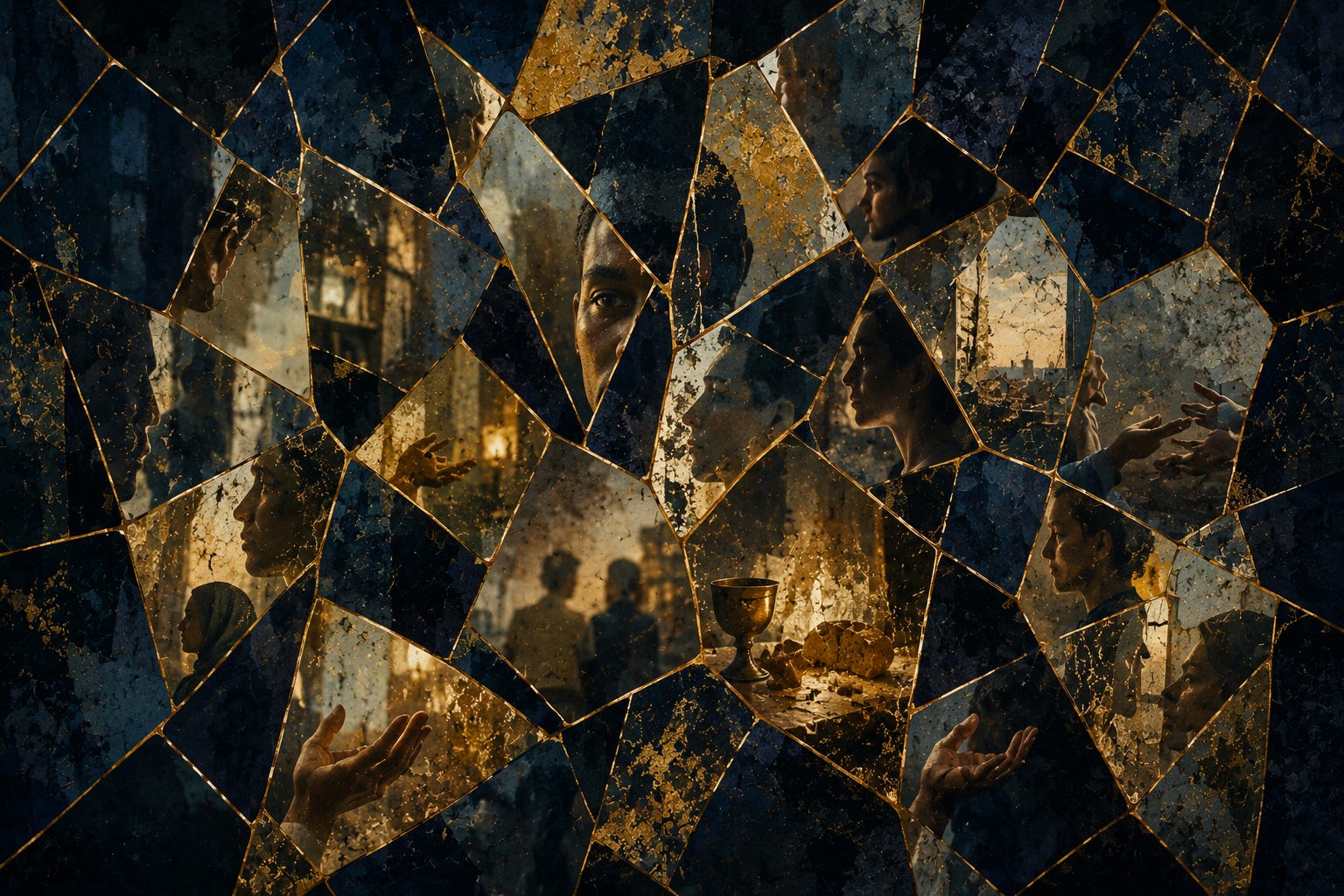
There is a moment in the liturgy each Sunday when we kneel or stand together and confess that we have not loved God with our whole heart, and we have not loved our neighbors as ourselves. We say it as a body, in the plural. We have not measured up. And then we keep going. The service does not end there. The bread is still broken. The cup is still shared. We are still fed.
I have come to think this is one of the most theologically honest moments in our common worship. Not because it is sad, but because of what it is. It is the doorway, not the destination. Our common worship, the rest of the day, the rest of the Christian life: all of it is what comes after the acknowledgment. We do not stay in the doorway. We walk through it.
But the confession assumes something underneath it. We could not have failed to love God with our whole heart unless we were the kind of creatures who were made to. The not-measuring-up only makes sense because there is something we were measured against. The doorway opens onto a question about what that something is.
What does it actually mean that we were made in the image of God?
The Authorized Icon
The ancient world was full of images of gods. They filled temples and palaces and tombs. The gods of Egypt, of Babylon, of Greece. Every one of them had statues, reliefs, painted faces. Worship meant approaching the image. The image was where the god could be found.
The God of Israel forbade images, and then made one anyway. Out of dust.
This is the strangeness of Genesis 1 that we have learned to read past. Let us make humankind in our image, after our likeness. The God who refused to be represented in stone or wood or beaten metal chose, from the beginning, to be represented in us. Humanity is not one image-bearer among many. It is the only living icon of God within the created order. The world is crowded with living temples.
I do not think we feel this anymore, most days. It is too large to feel. But it is the thing we have to keep coming back to, because everything else this truth asks of us depends on it. Every person you have ever met, the difficult ones, the easy ones, the ones you love, the ones you cannot stand, is a place where the living God has chosen to become visible.
What This Says About God
It tells us, first, that God wills to be known. The same God who told Moses no one could see his face chose to fill the world with living signs of his presence.
It tells us, second, that God is not solitary. Let us make humankind in our image. Christians have long heard, in that strange plural, an echo of the triune life of God. The image we bear comes from a God whose own life is communion.
And it tells us what kind of authority God exercises. The first chapter of Genesis is not a story about a God who clutches authority tightly to himself. It is a story about a God who shares it. Dominion, fruitfulness, cultivation, naming. All of it is handed over. The pattern of divine rule, from the beginning, is generosity.
What This Says About Us
We are not accidents. We are meant, placed in the world as living signs of the One who placed us.
And the image is not a property we carry around like a hidden coin. It is a vocation. Genesis 1 does not define the image and then assign tasks; it defines the image through the tasks themselves. Be fruitful. Fill. Subdue. Have dominion. Name. To bear the image is to do the kind of work God does: bringing order out of chaos, cultivating what has been given, naming things truthfully, generating life, exercising authority that serves rather than consumes. When we do those things, the image is being borne. When we do not, the image is being veiled. Not lost, but obscured.
The image is also relational at its core. “Male and female he created them” arrives in the same breath as “in the image of God.” The image is borne between persons, not only within them. Whatever else we want to say about how human beings belong to one another, this is the floor. The image was never meant to be a private possession.
And the image is bestowed, not earned. Genesis 1 does not make image-bearing conditional on behavior. Humans are image-bearers before they have done anything at all. The gift grants dignity before it asks anything in return. We did not produce this and we cannot lose it.
Three Motions
So how do we live like this? The liturgy, in its quiet and repetitive way, has been training us all along. There are three motions, and we make them every Sunday, often without noticing.
Toward God, in worship. An image that forgets its source becomes an idol of itself. This is the failure mode of every age, including ours. We are made to point past ourselves to the One we represent, and when we stop doing that, we begin to mistake the image for the thing. Sunday worship, the Eucharist, the prayer of thanks said over a meal: these are habits of return. They are how we remember whose we are.
Toward creation, in cultivation. The verbs of Genesis 1 are not abstract. They show up in how we do our work, how we raise our children, how we tend whatever ground we have been given. To bear the image in the world is to work the world the way God works it: cultivating rather than extracting, naming truthfully rather than spinning, generating life rather than consuming it. This is as concrete as a garden, a classroom, a kitchen, an online post. Every place we touch is a place the image touches.
Toward one another, in recognition. This is the hardest motion, and it is where the calling of the image bearer opens out into its two hardest questions. One faces outward, toward the people we are tempted to dismiss. The other faces inward, toward the self we are tempted to despise. They are not separate questions. They share a root.
The Trap
I spend more time on the internet than I should. I suspect most of us do. And one of the things I have come to recognize about the Christianity that lives there is how quickly theological conviction can harden into tribal identity.
Catholic against Protestant. Traditional against progressive. The lines harden quickly, and contempt slides into the spaces between them.
I want to say this plainly. The thing that often masquerades as theological seriousness online is, in reality, the opposite of theological work. Real theology drives toward the unity of the body. Tribal theology drives toward the protection of one’s faction. The first is hard and slow and costly. The second is emotionally satisfying because it asks almost nothing except loyalty and outrage.
Jesus prayed, on the night before he died, that we would be one, as the Father and I are one. He did not pray for sameness. He prayed for a unity capable of holding difference within love.
The Catholic at adoration, the Pentecostal with hands lifted, the Orthodox priest behind the iconostasis, the Anglican opening Morning Prayer. All of them are icons-in-progress of the same Christ. The differences between them are real. They matter. They are worth working through honestly with patience and care. The contempt is not.
The person we are tempted to dismiss as a heretic in a comment thread is someone for whom Christ prayed in the upper room. To deface that person, even in our imagination, is to break an image God placed there. We are breaking what God is restoring.
The Weight
But there is the other side of this, too, and I do not want to leave it unsaid. Anyone who takes the calling of the image bearer seriously will, at some point, feel its weight. The gap between what we are called to be and what we actually are is real, and it does not go away when we name it. It can sit heavily on a person. It can become a kind of grief.
Three things have helped me hold the weight without being crushed by it.
The image is bestowed, not earned. You always are this. The question is never whether you are an image-bearer. The question is only how clearly the image is showing through on a given day. A bad day does not undo what was given on the sixth day of creation.
Christ has already done the work. He is the perfect image of the invisible God, and the Christian life is not a project of manufacturing likeness to God by sheer effort. It is the slower process of being conformed to the one we already resemble. We are being transformed into the same image, from one degree of glory to another. The verb is passive. Our job is to stay in the light.
And the liturgy is built for exactly this gap. Week after week, we confess that we have fallen short. We admit that we cannot stand before God on our own merits. And then, in the same service, we are invited forward anyway. The liturgy does not let us pretend we measure up. It also does not let our not-measuring-up be the last word. The last word is mercy. The last word is being fed anyway.
Paul distinguishes godly grief from worldly grief. Godly grief leads to repentance and life. Worldly grief leads to despair. The image-bearer who weeps for falling short and turns back toward God is doing what image-bearers are supposed to do. The image-bearer who concludes that failure has erased the image is believing a lie. The line between the two is fine, and most of us cross it both ways in the course of a week. The work is to keep crossing back.
The Inheritance
The two contempts, for the brother across the aisle and for the self in the mirror, share the same false premise. They both rest on the assumption that image-bearing is something we have to produce and defend. That if we do not perform it well enough, we will lose it. That if our neighbor performs it differently, they have lost theirs.
It does not work that way. It never did.
The image was given. It is being made clear. The work is to live as though that is true.
When the bread is placed in your hand on Sunday, it is being placed in the hand of an image-bearer who has not loved God with their whole heart and has not loved their neighbor as themselves. It is being placed there anyway. It is being placed in the hand of someone Christ prayed for in the upper room. It is being placed in the hand of a creature the living God chose, from the beginning, to become visible through.
The image you bear is not your accomplishment. It is your inheritance.