
The Knife and the Cup
What Abraham, Isaac, and a cup of cold water reveal about the mercy at the center.

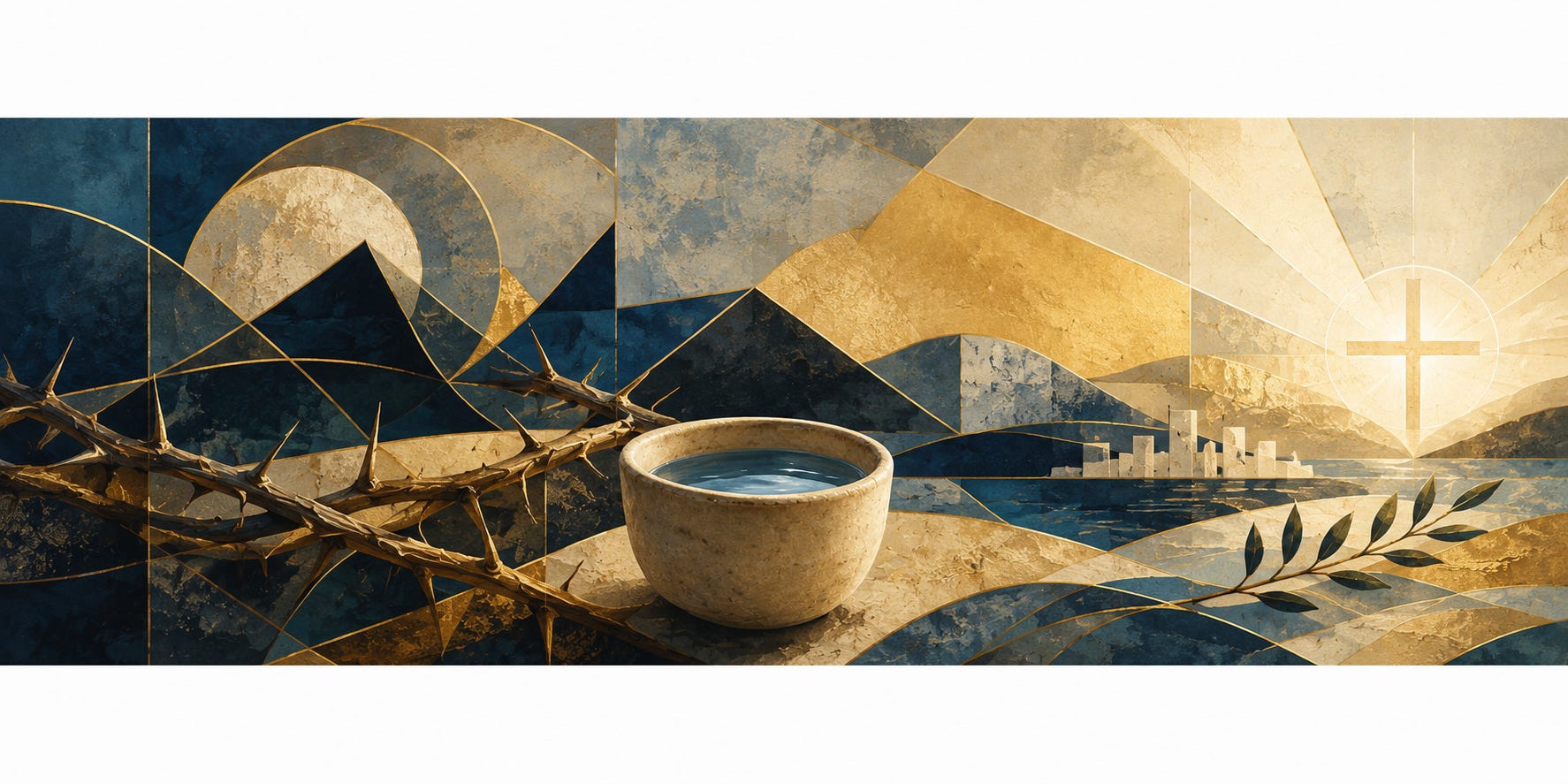
There is a knife in this story. It is better to say that first.
A father walks up a mountain with fire in one hand. His son carries the wood. The boy carries the very wood he will be laid on, and he does not know it. He knows only that something is missing. They have the fire. They have the wood. He asks where the lamb is.
The temptation is to soften it. Name it a test and the unease lifts, because a test has an answer, and the answer is that Abraham passed. Turn it into a lesson about obedience and move on. I have done this. For years I read Genesis 22 as a trial I was grateful never to be handed, and I let the gratitude carry me past the verses without looking at them.
The passage will not be made gentle. A father raises a blade over his bound child. The horror is not a flaw in the story. It is what the story refuses to let us avoid.
The Child on the Mountain
Abraham rises early. He splits the wood himself before the sun is up, saddles the donkey, and sets out. The ordinariness of the morning is its own kind of dread.
It takes three days to reach the place. Three days is a long time to walk beside someone you have been told to give up.
Isaac is old enough to carry wood and old enough to notice. He sees the fire and the knife and the absence at the center of the arrangement. Where is the lamb, he asks. His father answers without answering. God will provide the lamb, he says, and they walk on together.
At the top Abraham builds an altar and lays the wood in order. He binds his son. He lays the boy on the wood. He takes the knife in his hand. The text slows down here. Nothing is hurried. It will not let you look away.
The Church places Psalm 13 beside this reading, and the pairing matters. “How long will you hide your face from me?” is not an interruption of the mountain. It is part of how we are taught to stand there.
The God Who Provides
Then a voice.
Abraham, Abraham.
The hand stops.
He looks up, and there is a ram caught in a thicket by its horns. It has been there the whole time, or it has just arrived. The story does not explain. Abraham takes the ram and offers it in place of his son, and the boy goes free.
This is the turn the whole passage was bending toward. The child is not taken. Something is given instead of him. Abraham names the place The Lord Will Provide, and the name is also a confession of what almost did not happen.
Listen again to what he said on the way up. God will provide the lamb.
He said it before there was any lamb to see. He said it walking toward the place he could not bear to reach, and it turned out to be true, though not in the way fear expected.
A reader who knows where this language goes will feel the floor of it open. The lamb God provides is a long story, and it is not finished on this mountain. Christians cannot hear that sentence without hearing it bend, slowly and terribly, toward the Son who is not spared from the wood.
A Cup Instead of a Knife
The Gospel for this Sunday ends somewhere very different, and the distance matters.
The chapter that closes with these verses has spent itself on hard things. Take up the cross. Lose your life to find it. Do not expect peace. Love Christ more than father or mother, son or daughter. This is not gentle teaching either.
Then the demand turns small. Whoever gives a cup of cold water to one of these little ones, in the name of a disciple, will not lose the reward.
A cup of cold water. After all of that.
The discourse that asked for everything closes with the least thing a person can hand to another. Not because the demand has disappeared. Not because discipleship has become easy. But because the whole life Christ claims is often given back to us in the form of one small act of mercy.
The child almost taken on the mountain is not the same as the little one in the Gospel. But the lectionary lets them stand near each other: the child on the wood, the little one with a cup placed in his hands.
From the knife to the cup. From the son bound on the wood to the thirsty one welcomed in Christ’s name. The size of the gift has collapsed to almost nothing, and that is mercy.
The Mercy at the Center
The two stories are not the same. So why pair them?
One gives us a child bound on wood and a ram caught in the thicket. The other gives us a little one and a cup of cold water. One brings us to the edge of what we can hardly bear to read. The other places mercy within reach of any ordinary hand.
On Moriah, the demand looks total, and the mercy is a ram in a thicket. In the Gospel, the demand is still total, but the mercy is a cup you can carry in one hand. Everything is asked, and then what is needed is supplied, and then we are taught to pass it on.
So the knife is real. I will not tell you it is not.
But it is not the last thing on the mountain, and it is not the center of the story. The center is the provision. The center is the welcome of the little ones, where Christ says he himself is received.
There is a cup of cold water somewhere within your reach, and a little one who is thirsty.
Most days, you are not asked to climb Moriah. You are asked to notice the cup within reach, and the little one before you. You may find that this, too, is a place where God will provide.