Five O’Clock
When the day seems settled and God is not finished.
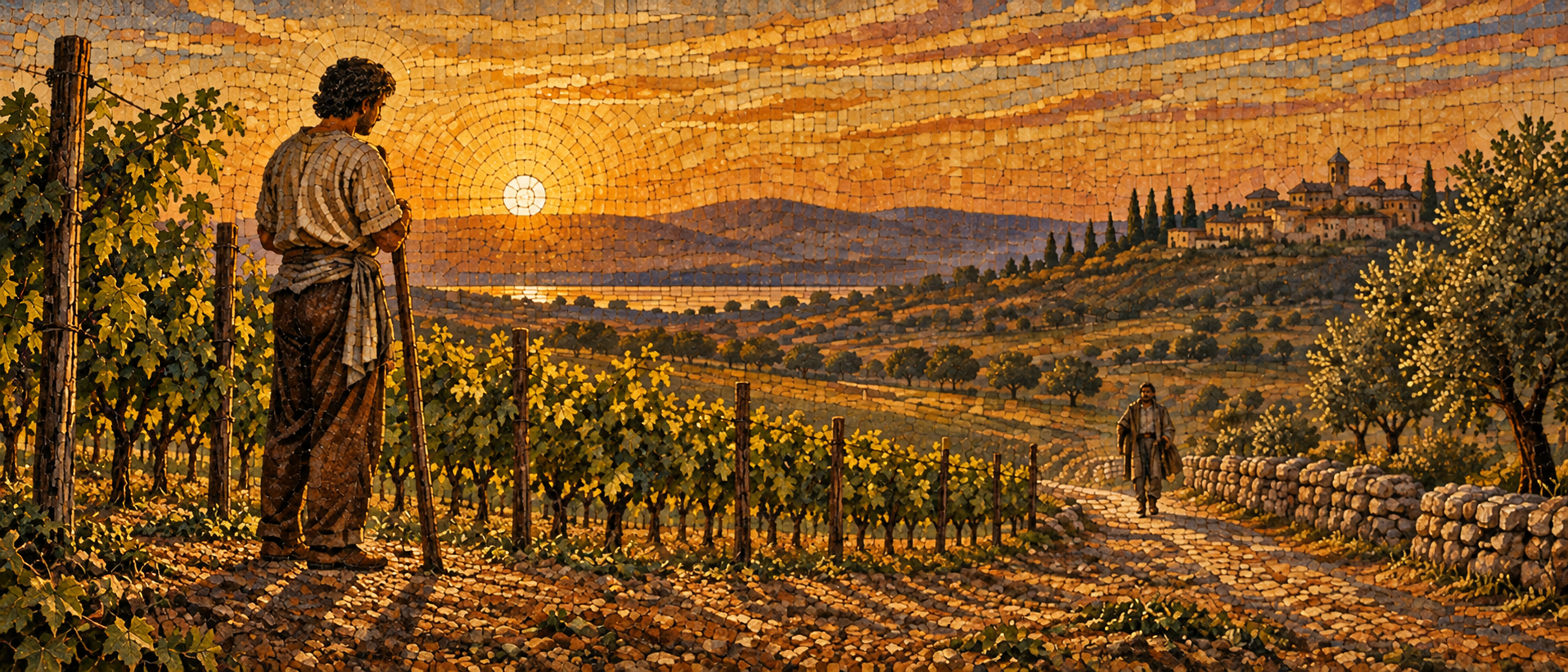
By five o’clock, the day is nearly over. The workers hired early in the morning have been in the vineyard for hours. Others were brought in at nine, then noon, then three. But when the landowner goes out again late in the afternoon, he still finds people standing in the marketplace. He asks them, “Why are you standing here idle all day?” Their answer is simple: “Because no one has hired us.”
There is something uncomfortable about the word idle. It sounds less like a description than a verdict. If they have been standing there all day while everyone else found work, we instinctively begin supplying the missing explanation ourselves. Perhaps they arrived late. Perhaps they were not trying very hard. Perhaps the other landowners saw something in them that made them pass by. We do not know. Jesus gives us none of that. He gives us only their answer: no one has hired us.
By five o’clock, that answer has probably begun to feel like more than an explanation. It has become the shape of the day. The morning is gone. Noon has passed. The workers who were chosen earlier are already deep into the work, and whatever possibilities existed at sunrise must now seem mostly closed. At some point, you stop expecting someone to come.
We know that feeling in other forms. There are moments when the broad shape of a life begins to seem settled. The work has been chosen. The family has taken its shape. The years have accumulated. Certain possibilities begin to look as though they belonged to an earlier version of us. We may not have consciously decided that nothing new can happen. We simply stop expecting it to.
Think of a man who starts coming to church later in life. He sits near the back and fumbles through the service while everyone around him says the responses from memory. It is not that he spent his life rejecting any of this. He was not raised in it, no one ever invited him, and the years went by. Now he looks at people who have had decades of what he is just beginning. There may be gratitude in that moment, but there may also be the strange awareness that he has arrived at the beginning of something when much of his life is already behind him.
We tend to think beginnings belong to mornings. That may be why the strangest thing in this parable is not that people are still standing in the marketplace at five o’clock. It is that the landowner goes back for them. At dawn, hiring workers makes obvious sense. At nine there is still a full day ahead. Even at noon there are hours of work remaining. But by five, another trip to the marketplace is difficult to explain simply by the needs of the vineyard. Whatever work remains, there is very little time left to do it.
Still, he goes back. There are moments when the shape of a life seems mostly settled. Then the landowner goes out again. When he finds the workers, he does not ask them to account for the hours that have passed. He does not ask where they were at nine or why someone else did not choose them. He does not ask whether they have enough time left to make the trip worthwhile. He simply says, “You also go into the vineyard.”
Earlier in the day, the arrangements had been more explicit. The first workers agreed to the usual daily wage. When the landowner returned at nine, he told the people standing there that he would pay them whatever was right. But by five o’clock, even that assurance has disappeared. There is no discussion of what an hour will be worth and no promise about what they will receive at the end of it. There is only the invitation. “You also go into the vineyard.” And they go.
The landowner does not give them the morning back. He does not somehow turn five o’clock into dawn. The day really is far along. Whatever opportunities existed earlier are gone, and the parable does not pretend otherwise. His invitation is not an offer to recover what has been lost. It is an invitation into what is still possible. That distinction matters.
We spend a great deal of time imagining the life we might have lived if something had begun sooner. If we had found the work earlier. If we had recognized the calling earlier. If faith had become real to us earlier. If we had understood ourselves better, taken the risk, repaired the relationship, or listened when we were younger. Sometimes the delay was not ours. Sometimes it was. Usually the story is more complicated than either explanation.
But the landowner is not standing in the marketplace offering them a different past. He is offering them a place in the vineyard now.
When evening comes, the workers who arrived at five receive the full daily wage. Much can be said about the generosity of the landowner and the anger of those who worked from dawn. But there is something else worth noticing here. The invitation at five was not symbolic. The landowner did not bring them into the vineyard simply so they could say they had been there. Their late beginning was still a real beginning.
The day had not ended simply because most of it was behind them. That is harder to believe about our own lives than it sounds. At some point, we begin to treat certain doors as belonging to another season. We may still admire the person who walks through them, but we quietly exclude ourselves. That would have made sense ten years ago. I should have started that when I was younger. Someone else has been doing it too long for me to begin now. We can become so accustomed to the shape our life has taken that a new invitation feels almost inappropriate. Sometimes even foolish.
I know something of that feeling. I began writing these reflections later than I might have imagined, while still in the middle of work I have done for twenty years. There was no obvious reason to begin. I had not spent decades preparing to write them. There were people who had been doing this far longer and knew far more than I did. More than once, starting felt less like the next logical step than like something I should have begun years earlier, if I was going to begin at all.
But that assumes that I know when the important beginnings of my life are supposed to happen. The workers in the marketplace probably thought they knew too.
By five o’clock, the evidence seemed fairly convincing. Other people had been chosen. The day had moved on. The vineyard was already full of people who knew what they were doing. Whatever was going to happen had apparently happened without them. Then the landowner came back.
Maybe that is the part of the story worth carrying with us. Not the assurance that every unfinished dream will eventually happen, because Jesus makes no such promise. Not the idea that lost years do not matter, because they do. And not the comforting suggestion that it is never too late for anything. Sometimes it is.
But we may be too quick to decide which invitations God is finished making. We look at the hour and assume we know what can still begin. God may not.
There are moments when the shape of a life seems mostly settled. The work has been chosen, the years have accumulated, and we begin to assume that whatever was going to begin has already begun.
Then the landowner goes out again.