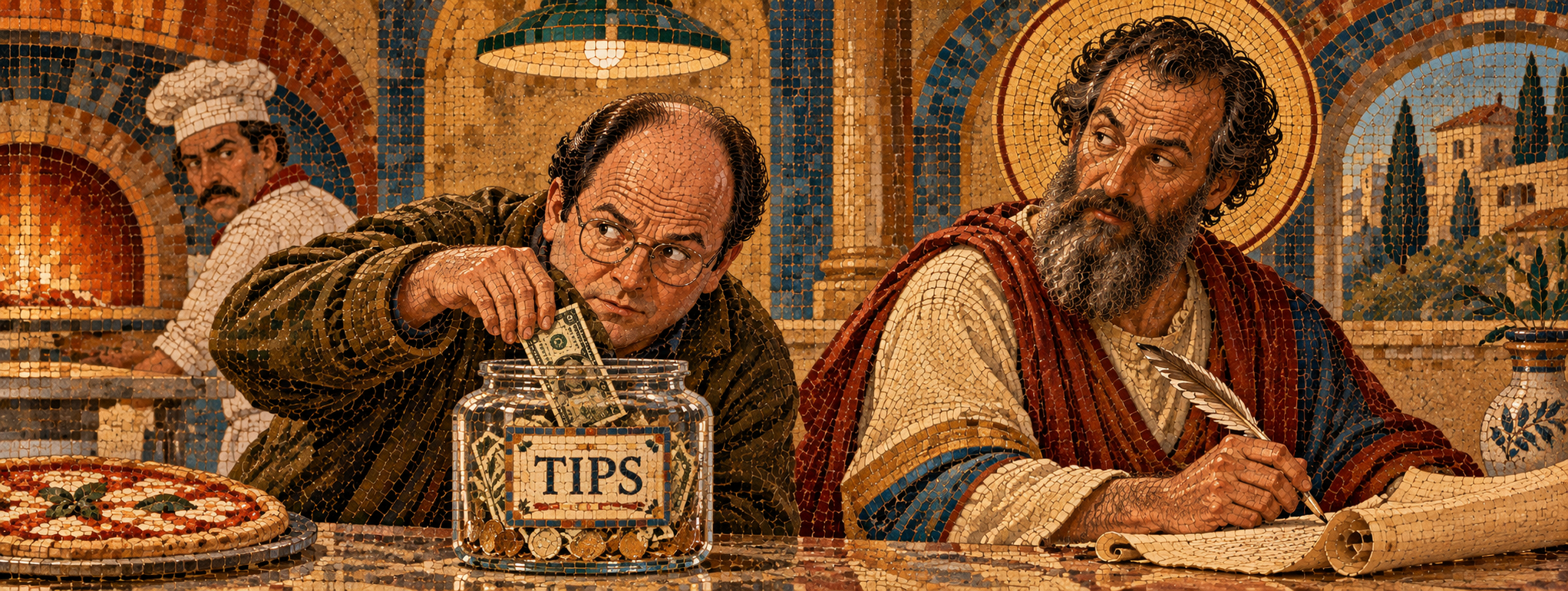
The Tip Jar
George Costanza wanted someone to notice his generosity. Saint Paul gave something far more valuable than a dollar, without demanding recognition in return. What can a Seinfeld tip jar teach us about the difference between giving and being seen?
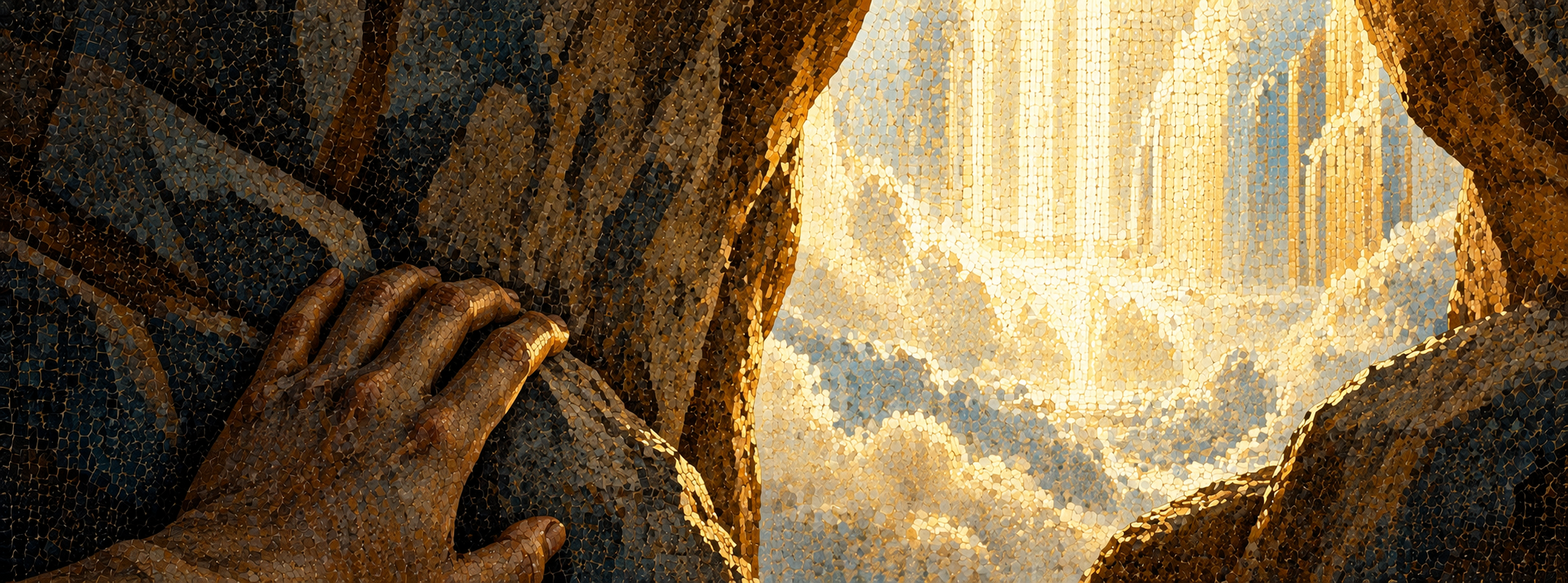
The Cleft of the Rock
We ask for certainty, for some unmistakable sign that God is near. Moses asked for something even greater: to see God’s glory. But what he received was shelter, a fleeting glimpse, and the promise of God’s presence. There is mercy in what remains hidden, even when we struggle to understand why. God does not always give us the clarity we seek, but He does not leave us to face the unknown alone.
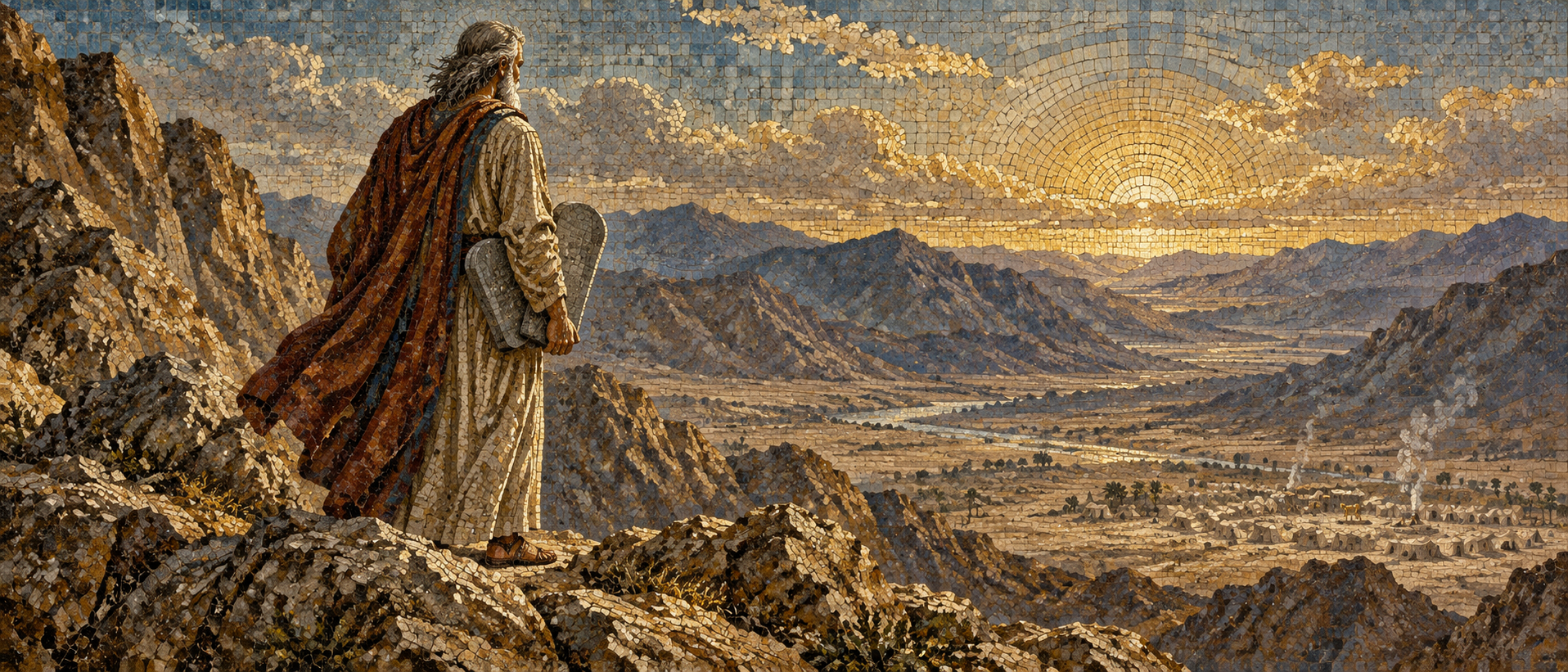
The Offer Moses Refused
When Israel gathers around the golden calf, Moses is offered a future without the people who have repeatedly disappointed him. He could begin again. Instead, he pleads for them, raising a difficult question about faithfulness: what responsibility remains when someone else’s failure gives us every reason to distance ourselves?
The Last Verse
Eight hundred years after St. Francis added death to the same song as sunlight, his Canticle still asks something of us: whether our life with God is large enough to hold not only what we welcome, but what we never would have chosen.
Room to Answer Again
We give certain answers so much weight that they begin to feel permanent. But Jesus’ parable of the two sons suggests something quieter and more hopeful: faithfulness is not always getting it right the first time. Sometimes it is having the humility to answer again.
Five O’Clock
We tend to think the important beginnings of a life belong to its mornings. But in Jesus’ parable, the landowner goes out again at five o’clock, when the day seems nearly decided. Five O’Clock is a reflection on the possibility that God may still be calling us into something new long after we assumed the shape of our life was already set.
More Than What You Owe
A debt can tell the truth about what we owe without telling the truth about what we are worth. In the parable of the unforgiving servant, Jesus reveals a mercy that does more than cancel an account. It refuses to let the account become the measure of the person.

When the Knock is at Our Door
It is easy to admire Jesus’ instructions about confronting someone when we imagine ourselves delivering the hard truth. The passage becomes considerably harder when the knock is at our own door and we are the one being asked to listen.

The Life You Cannot Save
We spend much of our lives trying to protect what we love from being lost. But Jesus asks a harder question: what if the effort to save our life is sometimes the very thing that keeps us from fully living it?

Who Do You Say That I Am?
Peter gets the answer right. What he does not yet understand is what that truth will mean. Faith often unfolds in the space between recognizing who Jesus is and learning to trust what that recognition asks of us.

She Came Anyway
She knew the boundary before she ever approached Jesus. What makes the Canaanite woman remarkable is not that she expected easy acceptance, but that she trusted his mercy more than the limits placed before her. She came anyway, believing even the crumbs would be enough.

The Fourth Watch
The disciples spent hours rowing against a wind they could not overcome, sent there by Jesus himself. Sometimes the hardest part of faith is not the storm, but believing God has not forgotten us while it lasts. Matthew’s account of the fourth watch offers a quieter hope: the darkest hour has never been the hour God abandons his people.

Bring it Here
The disciples count the loaves. Five. They count the fish. Two. They do the math and reach the obvious conclusion: it is not enough. But Jesus asks a different question. Not, “How can we get more?” but, “What do you have?” Before the miracle, there is an open hand. This reflection explores why God so often begins with what seems insufficient and why faith starts not with abundance, but with the willingness to place what little we have into Christ’s hands.

When Words Fail
There are prayers that never become complete sentences.
The ones that begin at three in the morning. The ones whispered beside hospital beds. Romans 8 offers an unexpected comfort: the Spirit meets us not after we find the right words, but precisely where they fail.

Before the Storm
Before the rain reaches the desert, it announces itself.
The light changes. The wind shifts. The scent of creosote rides in from storms still hidden beyond the mountains. Scripture suggests God’s work is often like that—already underway long before we recognize it.

The First Word
Hearing is something that happens to you. Listening is something you do.
To hear something faint, you have to stop making noise yourself. The Rule of St. Benedict begins with a single word: Listen. It is a command that still unsettles our hurried lives.

The Torch We Keep
A torch is not a monument. You cannot set it down and admire it. It burns while you hold it. It burns down as it burns. It goes out unless someone keeps it lit.
The prayer appointed for this day remembers a torch, the torch of freedom the founders raised for people not yet born. But notice what the prayer does with the image. It does not ask us to stand guard over a flame already burning safely on its own. It asks for grace to keep receiving liberty as a living gift, something maintained not by memory alone, but in righteousness and peace. To pray it is to hope.

The Knife and the Cup
There is a knife in this story. It is better to say that first.
A father walks up a mountain with fire in one hand. His son carries the wood. The boy carries the very wood he will be laid on, and he does not know it. He knows only that something is missing. They have the fire. They have the wood. He asks where the lamb is.
The temptation is to soften it. Name it a test and the unease lifts, because a test has an answer, and the answer is that Abraham passed. Turn it into a lesson about obedience and move on. I have done this. For years I read Genesis 22 as a trial I was grateful never to be handed, and I let the gratitude carry me past the verses without looking at them.

Looking Back
It is a Thursday in June and I have found the day’s collect before I am fully awake. The coffee is not made. The light is still thin.
It is a prayer for Barnabas. I read it the way you read an inscription on a granite wall, with the gentle respect you give to someone safely gone.
And then the sentence reaches its real verb, the one I had skated past at the start, and I realize what it has been doing all along. Grant, O God, that we may follow the example of your faithful servant Barnabas. We. The prayer was never a description of a man long past. It was a request about me.

Come, Holy Spirit
When we love someone, we reach for them. We take a hand. We put an arm around their shoulder. The instinct is older than language and we never outgrow it.
And then there is the Spirit. Of the triune Persons we confess, the Spirit is the one we cannot picture. We can picture the Son. We have some sense of the Father. But the Spirit… Close your eyes and try to see the Spirit, and you will find no face appears.
And yet we keep the feast. We bring out the red. We celebrate what we cannot bring before the mind’s eye.