The Last Verse
Eight hundred years after Francis reached the last verse.
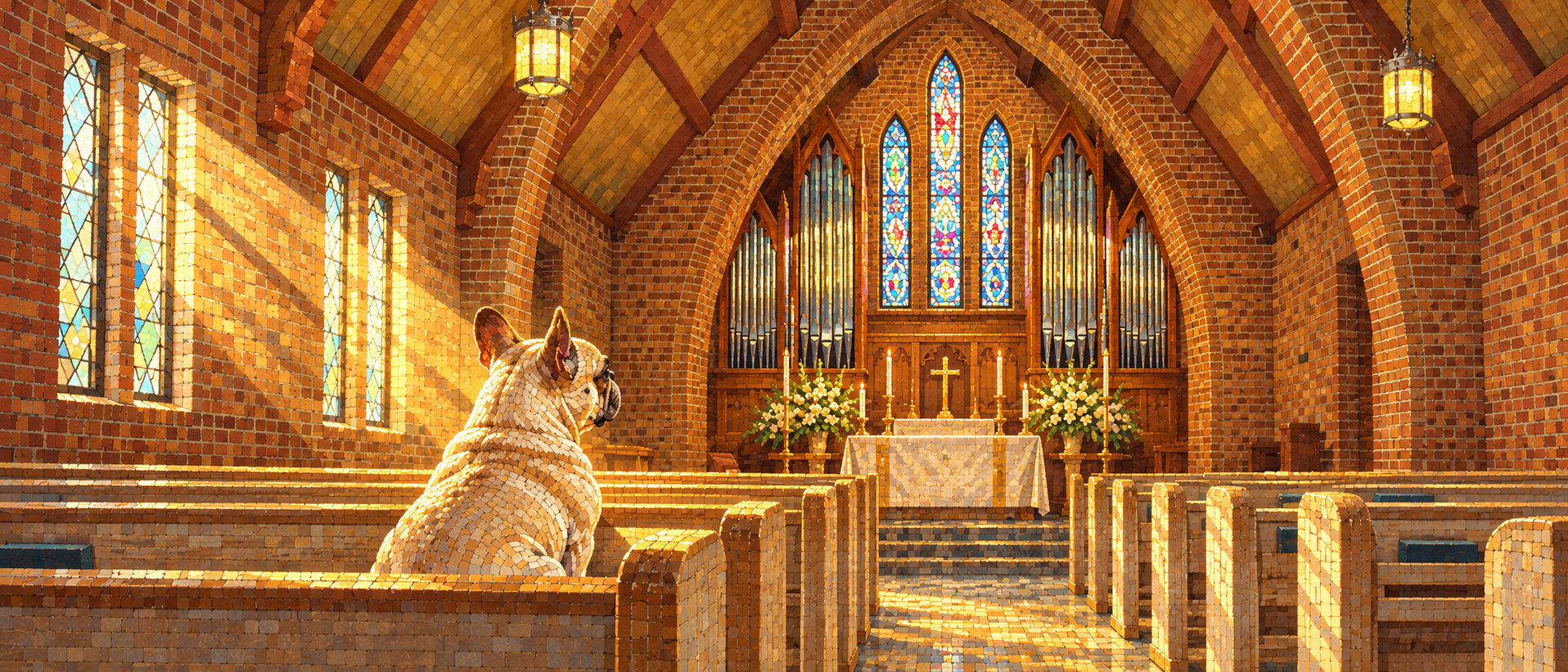
One of my children’s favorite traditions is taking our French Bulldog to church for the blessing of the animals on the Feast of Saint Francis. Before we moved to Arizona, we belonged to a beautiful little church on Bainbridge Island in Washington, where the dogs did not wait outside for a separate blessing. They came to the actual service.
I understand why most churches don’t do this. A sanctuary full of dogs is a liturgical risk. But I will never forget our little guy sitting on that wooden pew, listening to the organ and looking over the other parishioners as if he were deciding which of them he approved of.
The opening hymn was the one sung almost everywhere on that Sunday: All Creatures of Our God and King. Dogs shifted in the pews. A cat complained from its carrier. I don’t know if anyone in the room was thinking about the man behind the song, or what was happening to him when the words that became our hymn first took shape.
Francis did not write his Canticle all at once. In 1225, a year before his death, he was staying near San Damiano, the small church outside Assisi so closely tied to the beginning of his vocation. By then his health had deteriorated badly. His eyes were diseased and light itself could cause him pain. And yet the first creature he names is Brother Sun.
From there the song moves outward. The moon and stars. Wind and air. Sister Water, useful, humble, precious, and chaste. Brother Fire. Our sister Mother Earth, who sustains us and brings forth fruit, flowers, and herbs. These are the parts of Francis’s song that fit most naturally with the Sunday when we bring dogs to church. They are also the verses that are easiest to sing.
But the Canticle did not remain there. Some months later, the bishop of Assisi and the city’s mayor were locked in a bitter dispute. Francis was too ill to go and confront them himself, so he added lines praising those who forgive for the love of God and those who endure sickness and trial in peace. He then sent his brothers to sing the expanded Canticle before the two men. According to the early accounts, the encounter ended in reconciliation. Something had happened in Assisi that the original song did not yet contain, so the song grew.
Then Francis’s own illness worsened. As death drew near in 1226, he added again: “Praised be you, my Lord, through our Sister Bodily Death, from whom no one living can escape.” He had begun with sunlight. Now he put death into the same song.
The version we sing in The Hymnal 1982 preserves that movement. Sun and moon give way to wind, water and fire, then earth and its fruit. Later come forgiveness and suffering. Then comes death. Our hymn adds a final doxology, but Sister Death is the last new creature Francis himself brought into the Canticle.
Sung from beginning to end, then, this is more than a catalog of creation. It carries something of Francis’s final year within it. The song begins while his own world is becoming dark. It grows when a relationship in his city needs repairing. And near the end of his life, it expands once more to include the one creature from whom, as Francis writes, no living person can escape.
Every October, in churches full of dogs and cats and children, we can sing our way through all of that in about four minutes and never notice. I didn’t. And if I am honest, I would be perfectly happy for the hymn to end somewhere around the earth verse. Sun, wind, water, fruit and flowers are easy company. They belong naturally in a song of praise. Sister Death is different. We may sing the words, but most of us would rather remain several verses away.
I used to hear Francis’s final addition mainly as evidence of extraordinary courage, the sort of serene acceptance available to saints after the rest of us have left the room. I am less sure now. What interests me is not simply that Francis could speak about death this way. It is the way the Canticle had been growing before death ever entered it.
Francis did not begin by trying to make peace with mortality. He began with what was before him: light, wind, water, fire, earth. Then life presented something harder, a quarrel he could not fix with his own hands, and that entered the song too. His own suffering was there. Eventually death stood before him, and the prayer did not have to be discarded and replaced with another one. The song had learned to make room.
That may matter more to those of us who, we hope, are nowhere near Francis’s last verse. We tend to find it easier to bring certain things into our life with God than others. Gratitude belongs there. Beauty belongs there. Relief, joy, the things for which the word gift comes easily. Other parts of life are harder to place. We may pray for their removal or their repair, but we do not quite know what to do when they remain.
Francis does not require us to pretend those things are beautiful. There is a difference between praising God through something and praising the thing itself. Blindness did not have to become good. Conflict did not have to become desirable. Death did not have to become harmless. But none of them finally became a place from which God could no longer be thanked.
Perhaps that is what I had missed in the hymn. Faith does not only give us words for the parts of life that already make sense. Over time, if we allow it, prayer can become large enough to accompany us into the parts that do not.
We do not know what the next verse of our own lives will contain, and most of us would rather not know. There will be things we welcome easily and things we would never choose. The question is not whether we can greet all of them with Francis’s composure. I doubt I can. It may be enough, for now, to ask whether there are parts of our lives we have quietly decided must remain outside the song.
By the time Francis reached his final verse, he had spent a year returning to the same act: taking what was actually before him and bringing it into the presence of God. The sun. The wind. The water. A quarrel that needed mending. His own failing body. When death finally came near, perhaps he did not need an entirely different prayer. He only needed the next line.
Francis died on the evening of October 3, 1226. Eight hundred years ago this weekend, he reached the last verse. Many of us are still somewhere in the early ones: sun, wind, water, a small dog on a wooden pew, listening to the organ as though the alleluias were meant for him.
Maybe they were.