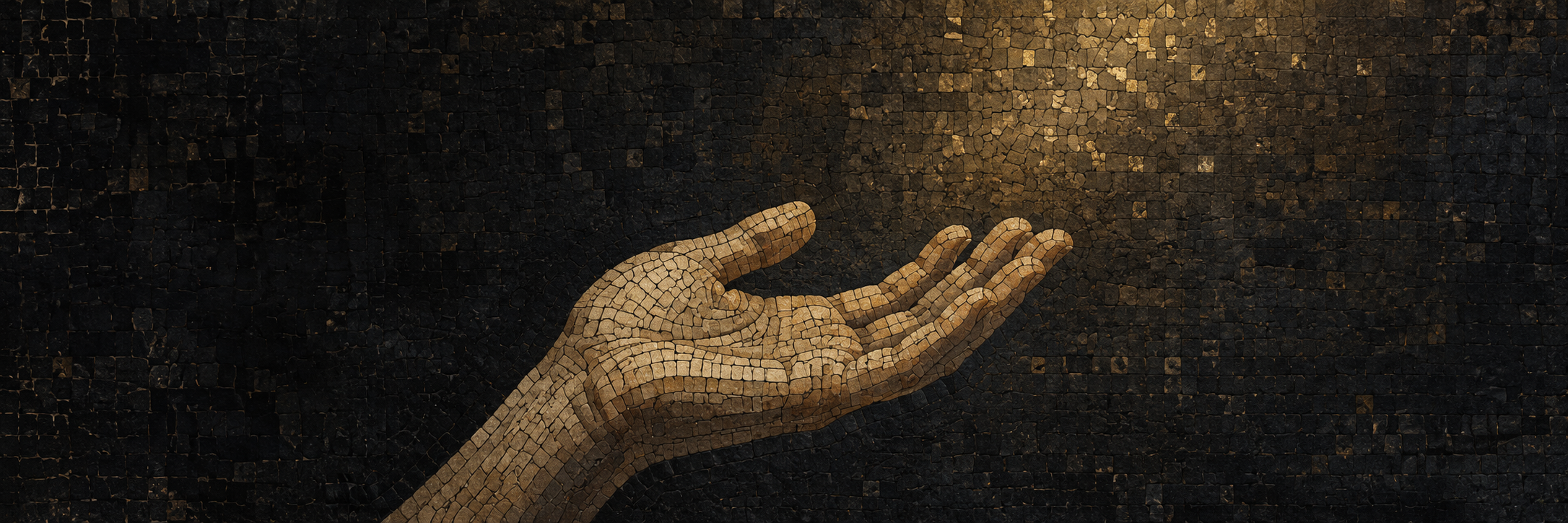
Some things can only be received with open hands.
The house we recently bought came with a fireproof safe in the closet. The previous owners left it behind, emptied, unlocked, the door standing slightly open, as if it had finished its work. I keep wondering what they kept in it. Birth certificates, probably. Legal documents, passports, maybe a grandmother’s ring, maybe letters. Whatever it was, these were the things they had decided must survive. If the house burned, these were the items that must be saved.
There is nothing trivial about wanting to protect what matters. For some people, the papers in a fireproof box are the documents that establish who they are or where they belong; the few things left after a death; what cannot be replaced after a fire. The point is not that we should be careless with what can be lost. It is that even the things we are right to protect cannot finally give us the security we ask of them.
We have owned the safe for months now and still haven’t really figured out what to put in it. It sits there, waiting, asking a question we apparently cannot answer quickly: what, exactly, are you trying to save?
I find the thing strangely moving. It is a physical confession of what we already know, that things burn, that we are not in charge of as much as we pretend. And it is also a physical hope: that if we are careful enough, the important things can be kept from changing, breaking, leaving, or being lost.
Most of that carefulness is wisdom. We plan, save, insure, prepare, protect, anticipate. But underneath the wisdom there can sit something quieter and hungrier: the hope that carefulness itself might save us.
In the sixteenth chapter of Matthew, Jesus tells his disciples plainly where the road ahead of him leads. He will go to Jerusalem. He will suffer at the hands of the elders and chief priests and scribes. He will be killed, and on the third day raised. Peter pulls him aside and objects.
What Jesus has just described is not an interior posture. It is arrest, humiliation, and death. When he then tells them to take up their cross, he is not using a metaphor they would have found gentle. A cross was an instrument of Roman execution. They would have heard cost before they heard metaphor.
Jesus rebukes Peter. But then he does something more. He turns from Peter to all the disciples and widens the conversation beyond what will happen to him. “Those who want to save their life will lose it, and those who lose their life for my sake will find it.”
The last three words matter. Jesus is not offering a general technique for a less anxious life. He is asking for a particular allegiance. The loss he names is bound to following him, not to self-improvement, not to a more spacious spirituality, but to the one who has just named the road to Jerusalem and refused to leave it.
That is a strange thing to say to people who have just heard him speak about his own death. Peter wants the loss stopped. Jesus does not reassure him that there will be no loss. Instead, he questions the assumption underneath the objection: that saving a life necessarily means keeping it from being lost.
The line sounds severe on first hearing. It has been read severely, sometimes to people who had already lost too much. But I wonder if Jesus is naming something we already half know, the way you know a thing before you can say it: that a life organized around preventing loss can become too guarded to be fully lived.
We run the same math in our heads every day. Keeping equals success. Losing equals failure. So we hold tightly. To the life we imagined, the person we used to be, the future we planned years ago and have been quietly editing reality to match.
None of these are bad things to love. But there is a difference between caring for what has been given to us and believing we can keep it forever. Here is where the math starts to cost something.
We avoid vulnerability so that we cannot be rejected, and find we also cannot be known. We avoid change because the familiar feels safer, and the familiar slowly becomes a smaller and smaller room. We refuse to admit we were wrong because it threatens the person we believe ourselves to be, and so we keep defending an identity we no longer recognize as our own.
We hold onto resentment because forgiveness feels like surrendering something we are owed. We postpone generosity because we might need more later, and later keeps moving. We try to protect the people we love from every possible danger, and discover, painfully, that love itself requires allowing them their freedom, which is to say the possibility that they might get hurt.
Sometimes the effort to save our life slowly becomes the thing that keeps us from living it. Nobody chooses this. It accumulates.
It matters to say what this teaching is not. Jesus is not praising recklessness. He is not romanticizing suffering, and neither should we. Prudence is not the enemy of faith. We should protect children, leave dangerous situations, care for our bodies, save for winter, keep boundaries, avoid unnecessary harm. The safe in the closet is not a failure of discipleship.
The problem is not control. The problem is asking control to do what it cannot do: to save us from being human. Because being human means vulnerability. Everything we love is, in some sense, something we cannot permanently keep. Not because we love badly, but because we love at all. The people, the seasons, the strength, the certainties. All of it is given. We can receive it, care for it, even call it ours. We cannot make it stay. This is harder than “just let go.”
Which brings us back to the road Jesus described. What Peter sees ahead is everything that must be prevented. Jesus sees the same road and knows he must walk it.
Christianity has never claimed that loss is unreal. It does not ask us to pretend that graves are gardens or that grief is confusion. It makes a much stranger claim: that loss is not always the opposite of life. The cross is the supreme case, but Jesus did not stop at the cross. He said he would be killed, and on the third day raised. The gospel does not promise that nothing will be lost. It promises that the grave is not the last true sentence spoken over what has been lost.
And this, finally, is where the teaching stops being an idea and begins to describe the lives we actually live. Some of the most important things in life can only be experienced if we stop trying to possess them completely. To love someone is to accept vulnerability we did not negotiate. To raise a child is, from the first day, to begin releasing them. To forgive is to loosen our grip on a debt we could have kept collecting forever. To follow a calling may require setting down an identity that took decades to build. To follow him is to give up the demand that we know exactly how the story unfolds before agreeing to walk it with him.
A closed hand can hold tightly. It cannot receive anything new. That is not a punishment. It is just the shape of a hand.
Perhaps “losing our life” does not usually mean one dramatic act of sacrifice. Perhaps, for most of us, it happens in smaller relinquishments, made over and over, mostly unwitnessed: the future we cannot control, the self we have outgrown, the outcome we cannot guarantee, the person we cannot keep unchanged, the certainty we wish God would hand us and hasn’t.
We spend much of our lives trying not to lose what was never ours to keep forever. Jesus does not ask us to stop loving these things. He asks us to hold them differently, not with clenched fists, but with open hands.
Open hands are not empty because we stopped caring. They are open because the Jesus who asks us to lose our life is also the one who promises that life can be found again.
The safe is still in the closet. We haven’t decided what belongs inside it, and for now I am content to leave it that way. Because perhaps the life we cannot save is the life we can finally learn to live.