What Jesus asks for before the miracle.
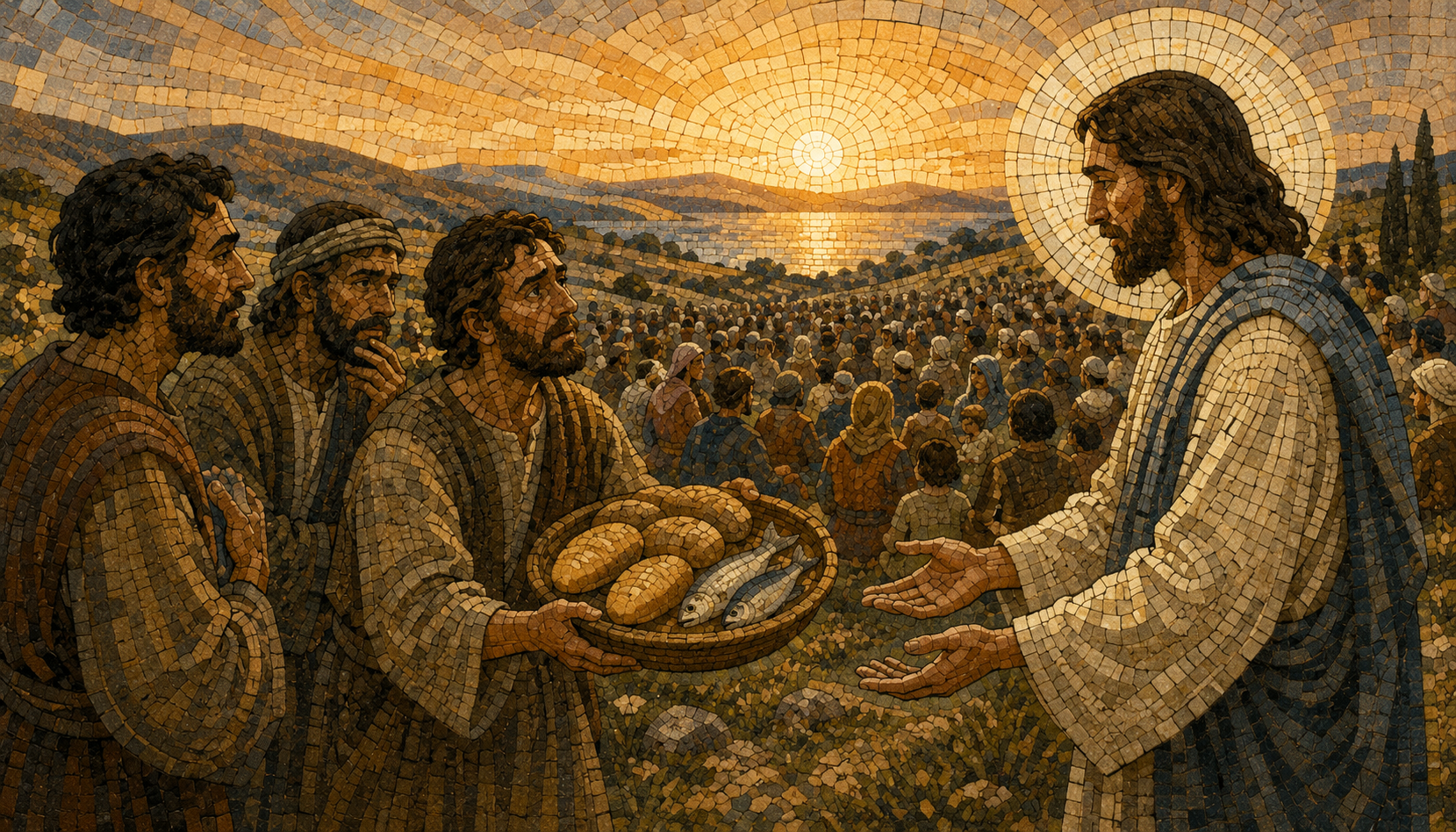
Evening comes down on a hillside. Thousands of people sit on the grass, tired and hungry, having followed Jesus into a deserted place. The disciples take inventory. They come back with numbers. Five loaves. Two fish. It is the whole of what they can find.
It is not enough. Everyone can see it is not enough. The disciples do the math the way anyone would. They count the mouths. They count the food. They tell Jesus the sensible thing: send the people away, let them buy their own dinner in the villages while there is still light.
Then Jesus says the sentence that unsettles the whole scene.
“You give them something to eat.”
God has a habit of beginning where sufficiency ends.
The Hard Part Is the Handing Over
The disciples are not wrong about the numbers. Five loaves will not feed a crowd. Their arithmetic is sound. What Jesus asks is not that they recalculate but that they act. Give them something to eat. Hand over the little you have while it is still, plainly, too little.
It is one thing to lack. It is another to give away the small thing in your hands before you can see how it could possibly be enough. The disciples are being asked to let go of their only provision on nothing but his word. No preview of the miracle. No guarantee returned in advance. Just the loaves and his open hands.
I can make peace with not having enough. What I resist is the letting go. Holding a little feels safer than opening my hands and letting it leave them.
Grace Comes Through, Not Around
This is the same Sunday the lectionary sets Jacob by the river. He has sent everyone he loves across the water ahead of him. He is alone in the dark. A stranger meets him there and wrestles him until the sky begins to gray. Jacob will not let go. He asks for a blessing and receives one, but he does not come away untouched. He comes away limping.
There is no shortcut in either story. The crowd is not fed by a table that appears from nowhere. Jacob is not blessed in his sleep.
God rarely removes the struggle we are facing before giving the blessing. More often, he meets us within it. Grace comes through the long night, the argument on the hillside, the reluctant open hand.
The Pattern
Look at where the great works of God start. An elderly couple, long past childbearing, promised a family as numerous as the stars. A shepherd boy with a sling and five smooth stones. A widow down to her last jar of oil. A cross on a hill outside the city, which looked to everyone watching like the end of a failed movement.
None of it looks like enough. That is not an accident. It is the pattern.
And notice what God does with these small, unpromising things. He rarely swaps them out for something better first. Moses keeps his shepherd’s staff. David keeps his sling. The widow keeps her oil, and it does not run dry. Grace does not bypass the ordinary in favor of something greater. It takes the staff, the sling, the jar, and the loaves, and it transforms them.
He Asks What You Have
The strangest moment in Matthew 14 is not the multiplication. Jesus never tells the disciples to go and find more. He does not send them back to the villages with a fuller purse. He asks a smaller and more searching question.
“What do you have?”
Then comes the invitation.
“Bring it here.”
The miracle begins with an inventory, not an acquisition. It begins with five loaves and two fish, carried across the grass and placed in his hands. God starts by inviting your to bring what you already carry.
Take, Bless, Break, Give
Watch his hands. He takes the bread. He blesses it. He breaks it. He gives it away. Christians have been doing those four things ever since, gathered around a table.
Take.
Bless.
Break.
Give.
The same motions that fed a hillside are the motions of the Lord’s Supper, the meal the Church calls the Eucharist, where basic bread becomes the way Christ still feeds his people.
So the feeding is more than a story about a hungry afternoon. It is a rehearsal. It shows how God means to work. Not by rejecting the ordinary loaf, but by taking it up, blessing it, breaking it, and giving it back as something no one at that table could have predicted.
What Has He Placed in Your Hands?
Maybe the question Jesus asked that evening is the one he is still asking.
Not, what do you wish you had?
But, what have I already given you?
Your family. Your school. Your work. Your table, and whoever sits at it. The street you live on. The hours in your ordinary day. The small, unremarkable gifts you have stopped noticing because they have never felt like enough to matter.
Control asks, “What else do I need?”
Faith asks, “What can I place into Christ’s hands?”
The question this story leaves us with is not whether we have enough, but what we have been reluctant to place into Christ’s hands. That is where the story locates the miracle. Not in abundance. In the handing over.
Where the Miracle Begins
The miracle did not begin when thousands were fed. It began earlier, and smaller. It began when someone carried five loaves and two fish across the grass and let them go.
And that is still where miracles begin. Not on the day we finally have enough, but on the day we open our hands and entrust what little rests there to the One who has always been enough.