Faith in the abundance of God.
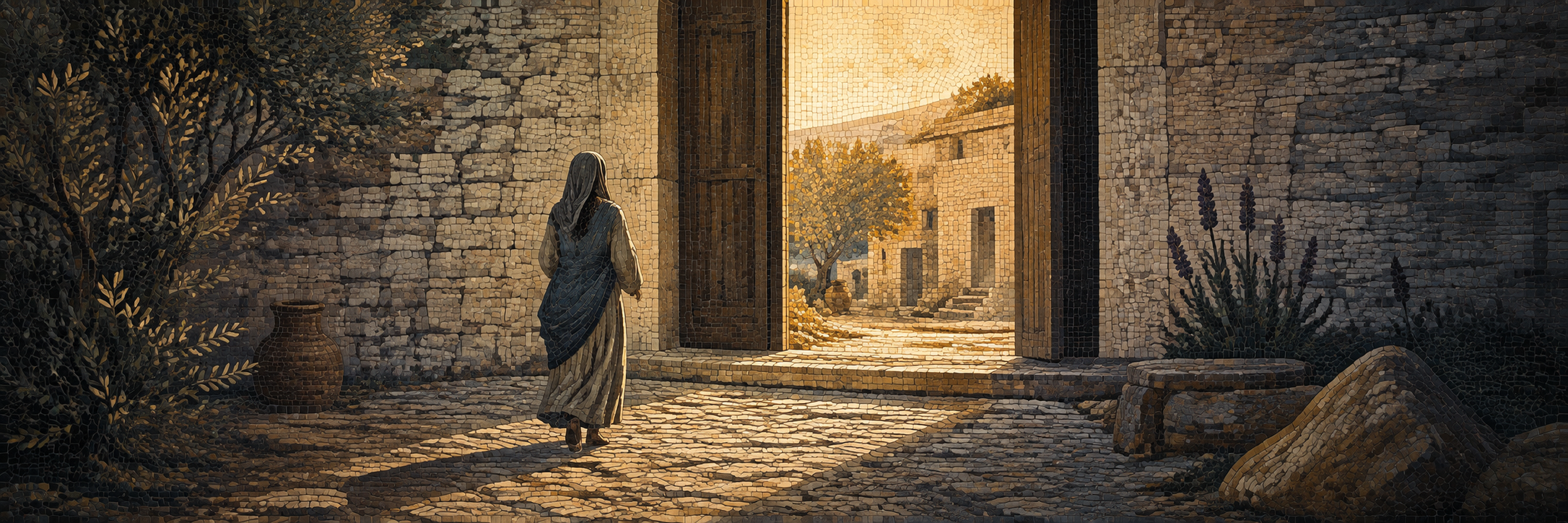
She knew before she left the house. She was a Canaanite. He was an itinerant Jewish teacher. The boundary between them was older than either of them, older than the towns they stood in, and Matthew will not let us miss it. He does not identify her as Mark does, a Greek, Syrophoenician by birth. Matthew reaches backward for an older, more loaded name: Canaanite.
So when the resistance comes, it cannot have been entirely unexpected. She had walked toward a boundary she already knew was there. The surprise in this story is not that she meets resistance. It is that she comes anyway. She comes crying out, and the words she chooses must have been strange in her mouth.
Lord, Son of David.
That is Israel’s hope, spoken by someone Israel unquestionably identified as an outsider. Somewhere, outside the circle where such things were taught, she has come to a conclusion about who this man is. We are not told how. We are told only that she arrives already believing it, with a daughter at home who is suffering, and nothing in her hands.
Notice what her faith is made of. She has no healing to point to yet. No answered prayer. No standing. She does not approach Jesus because she has a claim on him. She approaches because she believes something about him. The believing comes first. Everything else in the story follows.
Then the story becomes hard, and it is better to say that plainly. First he says nothing at all. The silence sits there and speaks volumes. The disciples want her sent away; her crying is a problem to be managed. When Jesus finally speaks, it is to name his mission to the lost sheep of Israel, a household she is not part of.
When she kneels and asks again, Lord, help me, he gives the boundary its sharpest possible shape.
It is not fair to take the children’s bread and throw it to the dogs.
There is no reading of that sentence that removes the sting, and we should not try to find one. The word lands where it lands. But notice what Jesus has not done. He has not introduced a boundary she could not have known existed. She came already understanding that she stood outside the household being described. And then she answers him.
Yes, Lord. Even the dogs eat the crumbs that fall from their masters’ table.
Look at what she does not do. She does not argue about the history or the injustice of the boundary. She does not demand a place at the table. She takes the image he has handed her, the household, the table, the dogs beneath it, and she steps inside it. And from inside it she notices something he did not mention. There are crumbs.
A table set for the children is still a table, and things fall from tables. Her whole answer rests on a single observation about the kind of feast this must be: abundant enough that even what drops from it unnoticed would be enough. Her answer can sound like self-abasement. I will take whatever is left.
It is the opposite. It may be the most confident sentence anyone speaks to Jesus in this Gospel. Look at what she is claiming. She is claiming that the overflow of his mercy, not the portion, not the seat, just the overflow, is sufficient to heal her daughter. She has measured the boundary in front of her, and she has measured what she believes about the one standing behind it, and she has decided the second is greater. She knows where she stands. She believes she knows who is standing before her. She trusts the second truth more than the first.
Most of us reverse that. We come to God as though we are pleading our case. Sometimes it is a case for ourselves: the record of our faithfulness, the prayers we have kept, the things we have done right. Sometimes it is a case against ourselves: the record of everywhere we have failed to be what we should have been. Either way, we arrive holding a ledger, and the ledger is about us.
The Canaanite woman carries nothing. Just verses earlier, Jesus had said that what comes from the heart is what reveals a person. She opens her mouth and what comes out is faith.
Here is the thing the crumbs reveal, and it is the center of the story. Crumbs are not evidence of scarcity. They are evidence of abundance. Nothing falls from an empty table. The disciples had already watched Jesus feed thousands and gather up baskets of what remained. The story has already shown us what happens when bread passes through his hands: there is more than enough. So if what drops unnoticed to the floor of this household is enough to heal her daughter, then what must the feast itself be?
Her answer is not a small request. It is an enormous claim about the size of what is being served. And notice what her claim does not require. She does not need there to be less for the children in order for there to be enough for her. She does not ask that anyone be moved down the table. Grace, as she understands it, is not zero-sum. The children keep their bread. The feast is simply greater.
Woman, great is your faith.
Jesus does not praise her wit, though the answer is witty. He does not praise her persistence, though she persisted. He names what he sees underneath both: faith. And it is worth sitting with the strangeness of the moment: the person standing outside every expected boundary in the story has recognized something about Jesus that the people closest to him struggle to grasp. Her faith was never confidence that she belonged. It was confidence that his mercy was greater.
She knew before she left the house. She knew the boundary. She knew, surely, that the answer might be no. She had every reason to finish God’s sentence before she ever made the journey to ask the question.
Most of us know that prayer. The one we have not said because we decided years ago how God would answer. The one we no longer bring because we think we already know what He will say.
She could have done the same. She came anyway. And then she walked home, through the same towns, past the same boundary, to a daughter who was well. She never sat at the table.
She was fed anyway.