The Cleft of the Rock
When the answer is a place to stand, not certainty.
Sometimes an answer doesn’t quite settle the question. We ask someone whether everything will be all right. They assure us that it will. We believe they mean it. We may even have good reason to trust them. And yet, a little later, we find ourselves asking again.
Perhaps we phrase the question differently. Perhaps we look for some additional detail, something we missed the first time. We want to know how things will work out, what might go wrong, whether there is something we haven’t considered. The reassurance was genuine. We simply wanted something more.
I’ve recognized this tendency in myself, particularly when something important feels unclear. I can receive encouragement, appreciate it, and still find myself searching for another reason to believe things will turn out as I hope. I’ve sometimes mistaken that restlessness for careful thinking. But I wonder whether what I’m really looking for is something no one can give me. Certainty.
There’s something familiar about this in the thirty-third chapter of Exodus. Moses is carrying an extraordinary responsibility. The Israelites have broken their covenant with God, and the future of their journey has become uncertain. These are people Moses has led out of Egypt, people who have complained, doubted, and repeatedly tested his patience. Now, after the incident of the golden calf, even the assurance of God’s continuing presence has become a matter of urgent concern.
Moses wants to know that God will remain with them. And God answers. “My presence will go with you, and I will give you rest.” It is a remarkable promise, particularly given everything that has happened. But Moses isn’t finished. He continues seeking assurance for the people, and eventually makes a request that seems to reach beyond everything God has already promised. “Show me your glory, I pray.”
I find myself lingering over those words. Moses has already encountered God in extraordinary ways. He has witnessed the deliverance from Egypt, the crossing of the sea, and the provision that sustained the Israelites in the wilderness. Earlier in this same chapter, we’re told that God spoke with Moses face to face, as one speaks with a friend. And still, Moses asks to see more.
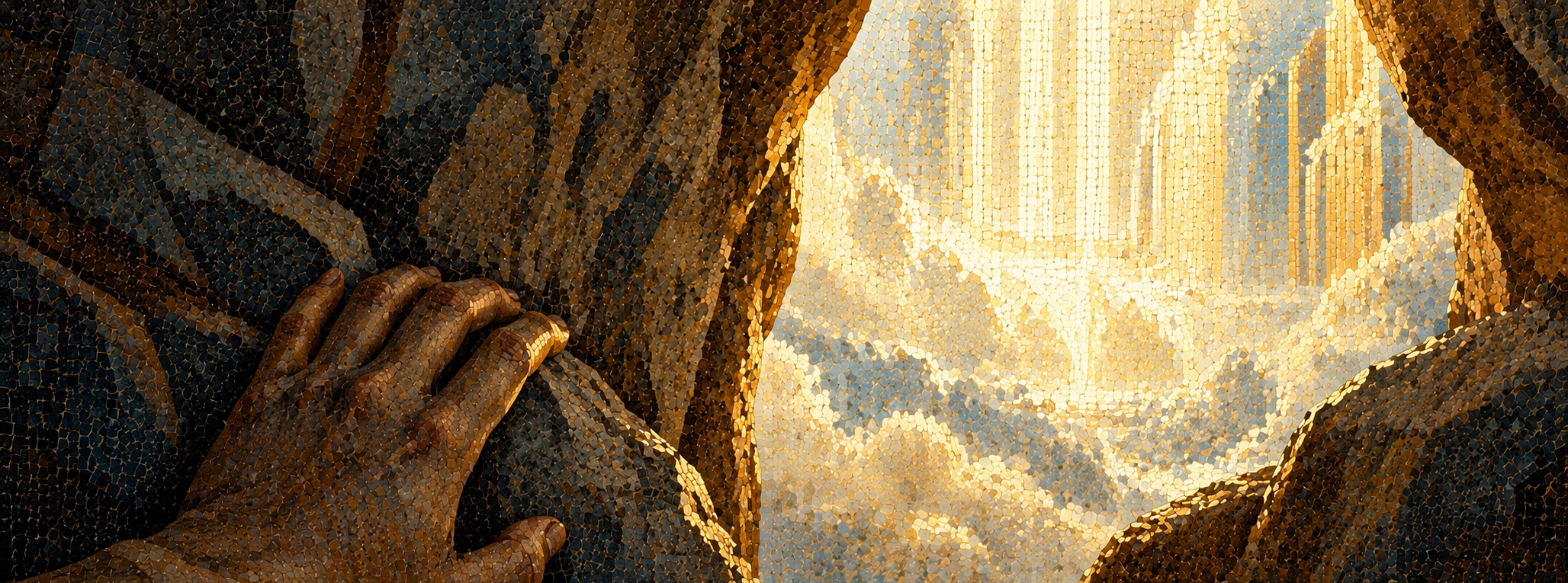
It would be easy to read this as a failure of trust. But the passage doesn’t seem interested in condemning Moses for his request. God responds with generosity, although not by giving Moses everything he asks for. God promises to make his goodness pass before Moses. He places him in the cleft of a rock and shelters him as his glory passes by. Moses will be permitted to see something, but not everything. There will be an encounter, but not a complete revelation. Moses will receive what he can bear. And afterward, he will still have a people to lead.
I wonder whether that is the part of the story we sometimes move past too quickly. These words have been studied, preached, and reflected upon for centuries. There is little reason to imagine that another reflection will uncover something generations before us have somehow missed. I feel that tension when I sit down to write about familiar passages. There is a temptation to search for an unexpected interpretation, some overlooked detail that will make the story feel new.
Could it be that the familiar words are not always asking us to discover something new? It seems that sometimes they are asking us to recognize something we have heard many times and still struggle to live. For me, that something may be the difference between reassurance and certainty. We often treat them as though they are interchangeable.
When we ask for reassurance, we may believe we’re asking whether someone will stand beside us, whether we have the strength to face what lies ahead, or whether the promises we’ve trusted remain true. But sometimes, beneath those questions, we’re asking for something else entirely. We want to know how the story ends. We want to know that the decision we’re making is the right one, that the relationship will survive, that the person we love will recover, that the future we’re working toward will arrive as we’ve imagined it. We want the uncertainty removed. And when reassurance doesn’t accomplish that, we keep asking.
There have been times when I’ve sought advice from people I trust, received thoughtful counsel, and then continued asking others essentially the same question. Not necessarily because the advice was inadequate, but because none of it could guarantee the outcome. I wasn’t always looking for wisdom. Sometimes I was looking for permission to stop worrying.
I think that’s why Moses’s encounter speaks to me. God does not give Moses a view of everything that lies ahead. He does not explain how every difficulty will be resolved or promise that the journey will become easy. He promises his presence. That is not a small thing. But neither is it the same as certainty. Part of the difficulty of faith is learning not to confuse the two.
I don’t think this means we should stop asking questions or seeking reassurance. Moses doesn’t stop asking, and God doesn’t turn away from him. Nor does faith require us to pretend that uncertainty is comfortable. There are circumstances in which the stakes are simply too high for easy confidence. But I wonder how often I have failed to recognize an answer because it didn’t eliminate the uncertainty that led me to ask. How often have I overlooked what was being offered because I was still waiting for something else?
There is so much beauty in the image of Moses sheltered in the rock. He has asked to see God’s glory, and God has drawn a boundary around what he can see. The rock itself becomes both limit and protection. Moses is not given everything he wants to know. He is not abandoned, either.
That is enough to leave me with a question I don’t particularly want to answer. What if the reassurance I’ve been asking for has already been given? What if the difficulty isn’t that I haven’t received an answer, but that I keep asking the answer to do something it was never meant to do?
I think of Moses emerging from the cleft of the rock. The wilderness is still there. The people are still waiting. The golden calf is gone, but the uncertainty it left behind remains. Moses still has a fractured community to lead and a journey whose ending he cannot see. He has not been shown how everything will turn out. But he has been reminded that he will not go alone.
And perhaps, for now, that is what he needed. Perhaps it is what I need, too.