George Costanza, Saint Paul, and the dollar nobody saw.
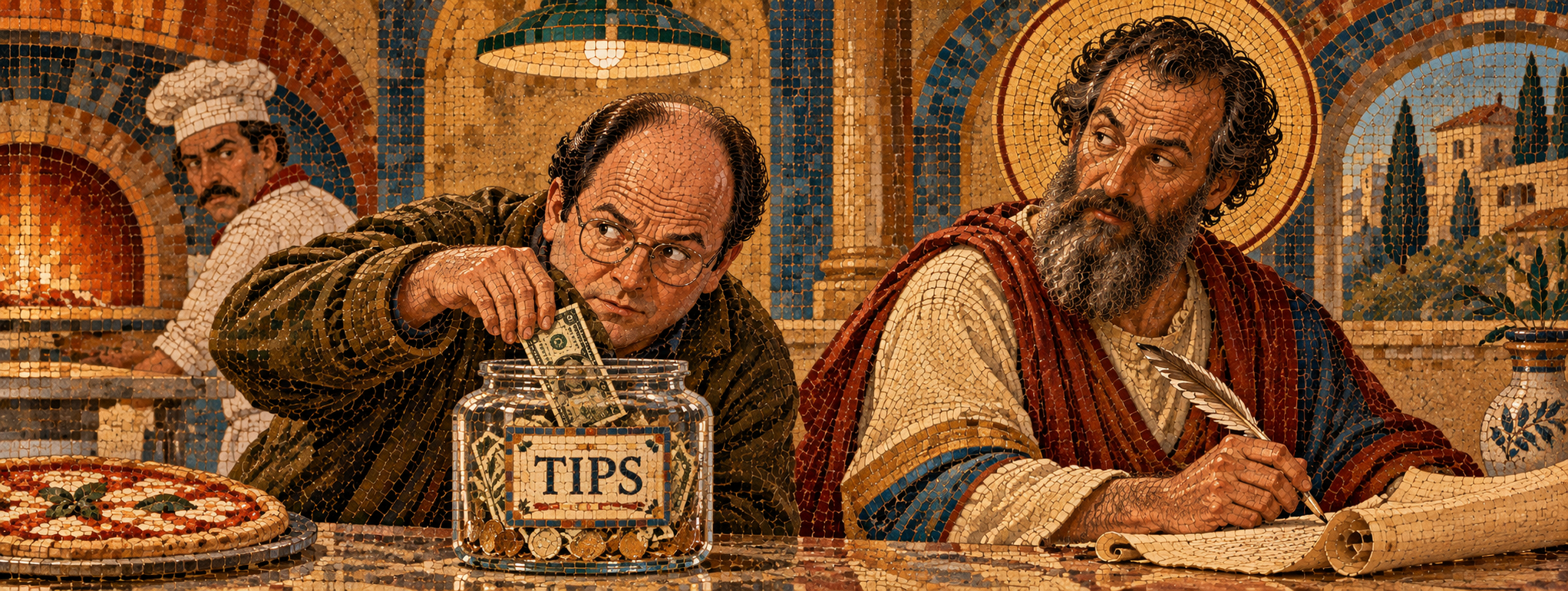
One of my guilty pleasures is Seinfeld. I’ve always loved how the show turns almost nothing into a whole episode: a parking spot, a Chinese restaurant waiting room, a tip jar.
In “The Calzone,” George is at Paisano’s, a pizza parlor in New York, and he drops a buck in the tip jar with what he hopes is visible generosity. But Mario the “calzone guy” is looking the other way, and George doesn’t get the acknowledgment. He tries to fish the dollar back out so he can tip again when someone’s actually watching. Mario turns just in time to catch his hand in the jar. He assumes George is stealing and bans him from the restaurant.
George tells Jerry about it. “It’s like I’m throwing a buck away. I mean, if they don’t notice it, what’s the point?” Jerry, deadpan: “So you don’t make a habit of giving to the blind?” George replies incredulously: “Not bills!” The tip was never for Mario. It was for the version of George that Mario was supposed to see.
The funny thing is that George really did give the dollar. What he couldn’t bear was the thought of getting nothing back. And that’s what brought me to Paul’s letter to the Thessalonians.
Paul had given the Thessalonians something considerably more costly than a dollar. He had given them his time, his affection, and eventually something of himself. But now, writing from a distance after being driven from their city, he simply trusted that they understood what he’d offered.
In Philippi he’d been beaten and jailed for preaching. In Thessalonica the crowds turned again: a mob, a night departure, gone before the work felt finished. Now he’s writing to people who might have wondered what his sudden exit meant. Had he abandoned them? Had they mattered as much as he’d said?
Here, Paul doesn’t offer a lengthy account of the riots or justify his departure. Instead, he asks them to remember. You yourselves know. Not simply asking them to take his word. Asking them to remember what they lived through together: the conversations, the ordinary hours, the experience of people who had become dear to one another.
Shared memory is his evidence, and he trusts it. There’s something almost stubborn about that. A man who could demand to be believed instead chooses to be remembered. And he’s careful to say what he wasn’t after. Not flattery and not glory. He spoke, he says, to please God, who tests our hearts. George, as Jerry discovered, didn't make a habit of giving to the blind. Paul, it turns out, was rather more generous.
Then the sentence that carries everything. “Being affectionately desirous of you, we were ready to share with you not only the gospel of God but also our own selves, because you had become very dear to us.”
The Greek word for selves here is psychas: lives, selves, the whole of a person, not a soul peeled off from a body. He’s placing the message and the messenger side by side, as if one without the other would be a distortion. A sermon can be preached again. A teaching can be repeated. But a life given in a particular place, to particular people, in a particular season cannot. It’s singular. And Paul hands his over to a church whose future he cannot control, whose faithfulness he cannot guarantee. He’s not offering a serene self. He’s a man with scars from Philippi, writing to people he had been forced to leave behind.
And the reason he gives for all of it is remarkably simple. Because you had become very dear to us. Not because they had earned it. Not because they could advance his ministry or secure his reputation. They had become dear to him. The giving wasn’t a strategy for winning their affection. It was what his affection had already made possible.
And here is where George and Paul part company. Both gave something. Both hoped for a response. But George wanted the response to come back to him. Paul wanted it to take root in the people he loved. George wanted to be thought generous. Paul wanted the Thessalonians to receive something worth giving his life for.
That’s not a new idea. Jesus didn’t wait to see if humanity would respond before giving himself. The cross isn’t God holding out a hand to see if we’d take it. It’s God giving everything while we’re still the ones hammering the nails.
Paul isn’t inventing self-giving. He encountered the risen Christ on a road outside Damascus, not in a crowd following him through Galilee. What he imitated wasn’t something he’d watched during Jesus’ earthly ministry. It was a love he had encountered himself, one that had already claimed him before he knew what to make of it. And now, in Thessalonica, that love takes on the shape of a human life offered to other people. Not just a message about what God has done, but something of the same generosity made visible in the messenger.
Paul doesn’t need a receipt for the gift. He cares what becomes of the Thessalonians. We know from the rest of the letter how deeply he rejoices to hear of their faith. But their response was never the price of his affection. He gave himself because they had become dear to him, not because he knew what they would give back. Jesus didn’t wait to be received before loving. Paul, writing from a distance to a church he can no longer stand beside, chooses the same.
I keep coming back to George at that counter. Not because he’s a villain. Because he’s so recognizable. How often do I do something good and quietly wait for the acknowledgment? A thank-you that doesn’t come. A gesture that goes unnoticed. And how quickly the generosity starts to feel like it didn’t count.
There’s a little George in all of us, standing at the jar, hand half in, hoping someone saw. Here’s one that won’t leave me alone. What would I give if I knew nobody would ever see me give it? Not the recipient, necessarily. But the people whose opinion of me matters. The ones I secretly hope will notice.
And if nobody ever did, would I leave the dollar in the jar?