On raising children in the Church, and teaching them why it matters.
Sunday mornings can require a certain amount of persuasion. There are children to wake, clothes to find, and occasionally a negotiation about why everyone needs to go to church in the first place. Sometimes the answer is simply, “Because it’s Sunday. That’s what we do.” And for a while, that’s enough.
But eventually there comes a Sunday when no one wakes them. No one reminds them what time the service begins. There is no expectation that they will be in the pew beside us. And the decision to go, or not to go, is entirely their own.
I think about this sometimes when I look around an Episcopal church and notice how few younger people are there. That isn’t true of every parish, of course, but it happens often enough to make me wonder about the generations who aren’t there. Where did they go? What did they take with them? And perhaps more importantly, what did we fail to give them before they left?
Psalm 78 offers an ancient instruction:
“We will recount to generations to come the praiseworthy deeds and the power of the Lord, and the wonderful works he has done.”
Psalm 78:4
It’s worth noticing what the psalmist asks us to pass along. Not simply the obligation to worship, or the customs of a religious life, but the stories of what God has done. And a few verses later, the psalmist tells us why: so that the generations to come might put their trust in God.
I wonder how often we confuse the two.
Our children may know that we go to church every Sunday. They may know when to stand, when to kneel, and which prayers to say. They may have attended Sunday school, memorized scripture, and learned what the Church teaches about God. But do they know why we believe?
Have we ever told them about the Sunday we almost didn’t go? The season when prayer seemed pointless? The disappointment that left us angry with God, or the morning we arrived at church carrying something we couldn’t bear alone? Have we told them about the forgiveness we didn’t think we were capable of? The unexpected kindness that changed something in us? The moments when faith stopped being something we had been taught and became something we had actually experienced?
Those may be the very stories that explain why we keep coming back. And the people who have sat beside us for years may never have heard them.
There is a remarkable moment in Mark’s Gospel when Jesus heals a man who has been living among the tombs, isolated from his community and tormented by forces beyond his control. After his healing, the man begs to accompany Jesus. It’s not difficult to understand why. His life has been transformed, and he wants to remain close to the one who made it possible.
But Jesus sends him home.
“Go home to your friends, and tell them how much the Lord has done for you, and what mercy he has shown you.”
Mark 5:19
I find that instruction extraordinary. Jesus doesn’t send him away with a set of teachings to memorize or arguments to defend. He sends him back to the people who knew him, carrying the story of what God has done in his life.
We spend years trying to give our children a foundation in faith. We bring them to worship, teach them to pray, and hope the familiar rhythms of the Church will become part of who they are. And there is genuine value in those habits. Sometimes we discover the meaning of a practice only after years of participating in it. Sometimes the prayers we learned before we understood them become the very words we need much later in life.
We want our children to enjoy coming to church, to build friendships, and to feel that they belong. There’s nothing wrong with movie nights, games, or sports. These can help build the relationships that make a church community meaningful.
But I worry about what we’re teaching when entertainment becomes the primary reason we give children to come. When we fill their time with activities they could find almost anywhere, while giving comparatively little attention to the Gospel, worship, and the traditions of our faith, what are we actually preparing them for?
We may unintentionally teach our children to approach church as consumers, measuring its value by whether they enjoyed themselves, whether it held their attention, or whether there was something exciting to do.
But much of what makes the Church meaningful cannot be measured that way. Prayer requires patience. Worship asks something of us. Scripture can challenge us. And belonging to a community means learning that our presence matters not only because of what we receive, but because of what we contribute.
Children eventually outgrow the games and activities we organize for them. But they need not outgrow the prayers, the sacraments, the traditions, or the invitation to serve others. Those are things they can spend a lifetime growing into.
We owe our children more than reasons to enjoy coming to church. We owe them an understanding of why faith is worth practicing, even when it isn’t entertaining.
Yet telling our children why faith matters isn’t always easy. Our experiences of God rarely arrive as neatly as the testimonies we sometimes hear. There are unanswered prayers, seasons of doubt, moments we still struggle to understand. We may hesitate to speak about God’s presence because we cannot fully explain it ourselves.
But perhaps that is precisely what our children need to hear. That the faith we have asked them to practice has also been something we have wrestled with, questioned, depended upon, and occasionally clung to when little else made sense.
Eventually, our children must decide for themselves what place faith will have in their lives. We cannot give them our encounters with God or guarantee that the Church will become as meaningful to them as it has been to us. But we can give them something of our memory. We can tell them where we’ve encountered mercy, when we’ve found hope, and why, through all the changing seasons of our lives, we have continued to return.
And there is another kind of story worth telling: not only what God has done for us, but what God has done through us.
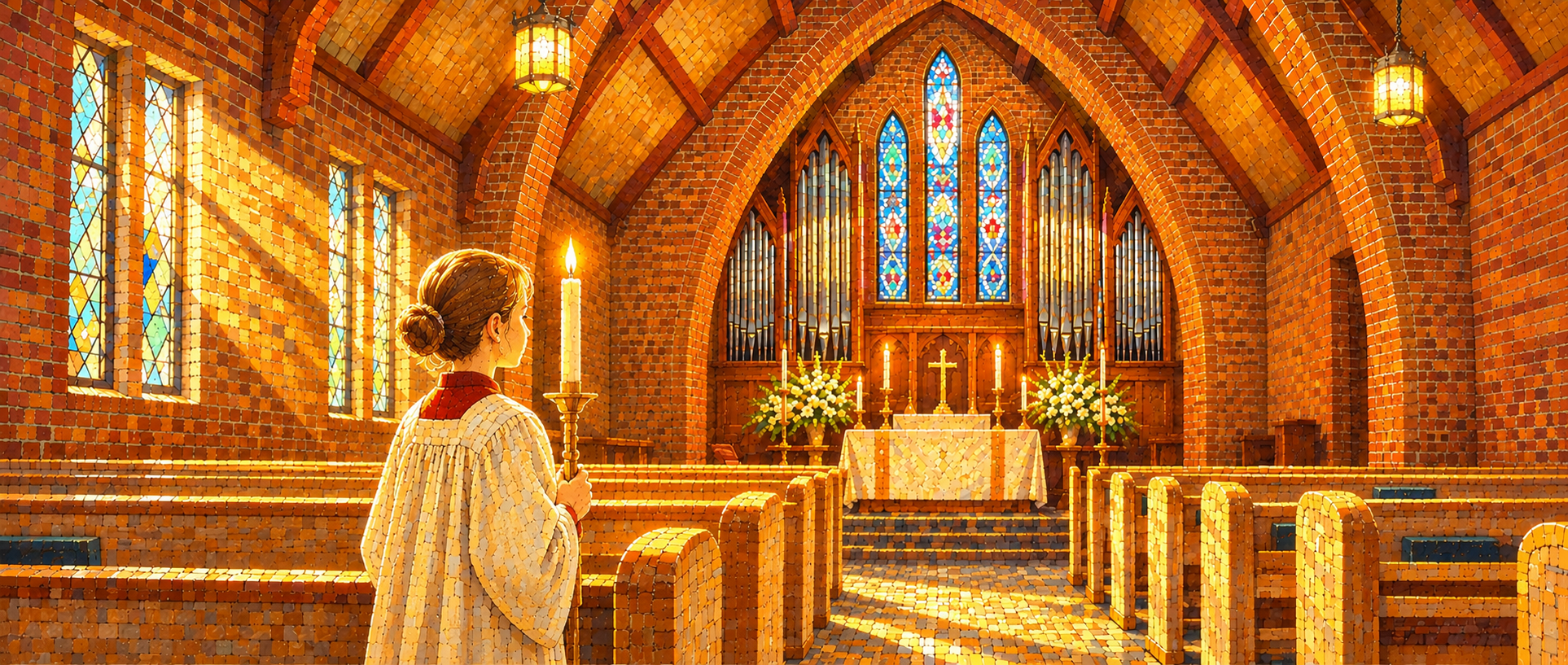
I think about my own family. My children have served as acolytes, read scripture aloud, and taken part in pageants. My wife has helped prepare the altar for worship, and I’ve offered readings and reflections during Advent. These are ordinary acts of participation in the life of the Church. They involve preparation, attention, and sometimes a little anxiety about getting everything right.
But something else happens in those moments. People have reached out to us because of our participation. Sometimes what seemed like a small contribution on our part meant something quite different to someone sitting in a pew.
An acolyte may think the task is simply to carry a candle and remember where to stand. A child reading scripture may be concentrating on getting the words right. But someone sitting in the pew may be carrying a grief we know nothing about, or searching for a reason to believe they are not alone. We rarely know what our presence means to another person. And I want my children to understand that the Church is not simply a place where we go to receive something. It is a place where, sometimes without even knowing it, we become part of what someone else needs.
There are stories we hesitate to tell our children because they can sound too much like boasting. The person we visited when they were alone. The family we helped through a difficult season. The Sunday we went to church not because we particularly needed to be there, but because someone else did. We tend to keep these things to ourselves, and there is good reason for that. Acts of kindness shouldn’t require an audience.
But our silence can also conceal something our children need to know about the life of faith. That belonging to a church means more than having somewhere to go when we need comfort, inspiration, or reassurance. It means becoming part of a community in which our presence matters to other people.
Sometimes we go because we need the prayers of others. And sometimes we go because someone else needs ours.
I think about the Sunday when my children will no longer need reminding that it’s time for church. There will be no one insisting they get dressed, no familiar expectation that they take their place beside us. The decision will be theirs. I don’t know what they will choose.
I hope they remember the prayers and the traditions, the candles and the readings, and the people who watched them grow. But more than that, I hope they remember why those things mattered to us. The stories of mercy and hope, the prayers that sustained us, and the ways we tried to live our faith beyond the church doors. I wonder how much of what made that place sacred to us we have actually put into words.
Before the choice is theirs alone, have we told them why we kept coming back?