On the saints we may not have recognized.
We can know someone for years and still know remarkably little about the life they have lived. We know their habits, their sense of humor, the familiar details of their days. Eventually we feel we know the person. But there is so much that never makes its way into conversation.
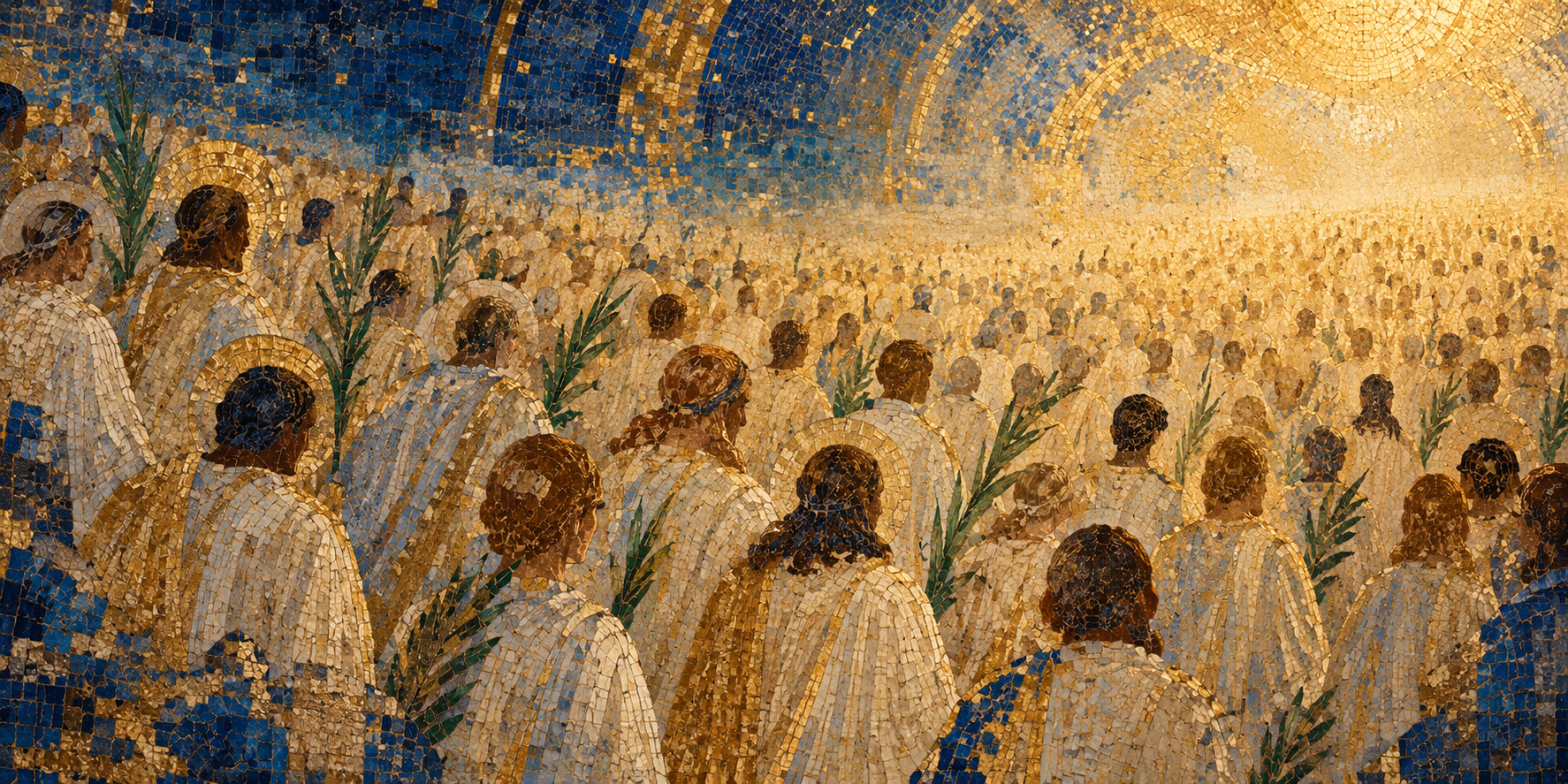
On the feast of All Saints, the reading from Revelation opens onto a scene almost impossible to imagine. John looks, and there before him is a great multitude that cannot be counted. They have come from every nation, from all tribes and peoples and languages. They stand before the throne and before the Lamb, dressed in white robes, holding palm branches. Their voices rise together in worship. The angels stand around the throne, the elders, and the four living creatures. Then the angels fall on their faces before the throne and worship God. It is a scene of such abundance that John can scarcely take it in.
And then, in the midst of all that splendor, one of the elders turns to him with a question. “Who are these, robed in white, and where have they come from?”
John answers, “Sir, you are the one that knows.”
John can see the multitude plainly. He can describe their clothing, their posture, their place before the throne. But when he is asked who they are, he leaves the answer to someone else. Perhaps it is simply respect for the elder. I believe there is something more for us there. John does not presume that seeing them is the same as knowing them.
The elder tells him: “These are they who have come out of the great ordeal; they have washed their robes and made them white in the blood of the Lamb.”
They have come through something. Their white robes are not evidence of lives untouched by difficulty. Nor is their suffering what makes them holy. Their place before God is bound to the Lamb, to the one who has himself passed through suffering and death.
But something else about this multitude stays with me. Before they stood there in white, before the palm branches and the singing, they lived lives somewhere. They had ordinary days. They woke in the morning with things to do and people to care for. They worried about what might happen next. They knew disappointment, and perhaps long stretches when nothing seemed to change. They had conversations, made promises, lost their patience, tried again. And most of the people around them would have known only a little of it.
I wonder sometimes how many people I’ve mistaken for the lives they appeared to be living. How often I’ve assumed someone was doing fine because they seemed fine. Or that someone had an easier road than I did because I never saw what it cost them to get through an ordinary day.
I think of the people we work alongside, the neighbors we exchange a few words with, the friends whose lives seem to be moving along without much difficulty. And how we sometimes learn something years later that changes the way we understood them. A loss they rarely mentioned. A marriage that was coming apart. A fear about one of their children. Something they had been living with quietly while the rest of the world went about its business.
How easily I might have passed through those years without noticing. The conversations that never went beyond the usual things. The questions I didn’t think to ask. Not because I could necessarily have changed anything. But because I realize how much I can assume about a life from the little of it I’ve been allowed to see.
And the same is true in the other direction. There have been seasons when what was happening outside bore little resemblance to what was happening within. Life continued as it usually did. There were places to be, responsibilities to meet, conversations to have. Most people would have had no reason to think anything was different. We become accustomed to seeing what is visible and filling in the rest ourselves.
The letter to the Hebrews speaks of being “surrounded by so great a cloud of witnesses.” I’ve always loved that image. A great company of those who have gone before us, whose lives of faith somehow continue to bear witness to our own. But this year, alongside John’s vision, I find myself imagining that cloud a little differently.
Not only the saints whose names we remember, whose lives have been written down and handed on through the centuries. But the countless others. The ones who lived quietly, who never imagined anyone would remember them. People whose faithfulness was woven into the ordinary circumstances of their lives, so closely that even those nearest to them might never have recognized it. They were not always a multitude dressed in white. Once, they were simply people living among other people.
And we live among people now. There is something almost overwhelming about that thought. That the great company John sees is made up of individual lives, each known completely to God, each with a story largely hidden from the people around them. And that, even now, we walk among lives whose full meaning we cannot possibly see. The cloud of witnesses begins to feel less like a distant assembly and more like a company that has always been closer than we imagined.
In the Gospel appointed for All Saints, Jesus begins the Beatitudes with words that must have sounded strange to those gathered around him. “Blessed are the poor in spirit, for theirs is the kingdom of heaven.” “Blessed are those who mourn, for they will be comforted.” “Blessed are the meek, for they will inherit the earth.”
How many of the people listening to him would have recognized themselves in those words. Would they have looked around at the others, trying to imagine whom Jesus might mean? We are so accustomed to recognizing a life by its visible qualities. Generosity when it is public. Courage when it is dramatic. Faith when it speaks with certainty.
But what about the faith that can barely speak at all? The person who is uncertain and keeps praying. The one who has grown weary of doing the right thing and does it again anyway. The person who has little to celebrate, but who has continued to love through circumstances that might have made someone else bitter. We might never know what any of that has cost them. Perhaps they wouldn’t think to tell us.
John’s first letter offers another way of understanding this distance between what is visible and what is true: “Beloved, we are God’s children now; what we will be has not yet been revealed.”
I have generally heard those words as a promise about what lies ahead. And they are. But lately I have been thinking about the first part. We are God’s children now. Not when our lives begin to resemble what we think holiness should look like. Not once everything uncertain or unfinished has been resolved. Now, while so much remains hidden, even from ourselves.
There is something both consoling and humbling in that. Consoling, because the parts of our lives that no one else can see are not beyond God’s knowledge. The grief we carry without explaining it. The efforts that seem to come to nothing. The difficult, unremarkable business of remaining faithful. Humbling, because it asks me to admit how little I know about the people around me.
In John’s vision, the multitude stands before the Lamb. And it is the Lamb who will shepherd them and guide them to springs of the water of life. The promise that God will wipe away every tear comes from the one who knows what tears are. No life in that multitude is anonymous to him. None of their stories has been lost.
I find myself returning to John’s answer. “Sir, you are the one that knows.”
There are lives I have passed through without understanding them. People whose courage I have missed, whose faith I have underestimated, whose burdens I never thought to ask about. Some of them may be among the saints.
I would like to think I would recognize one.
I’m not sure I have.